
Creator partnerships: how to structure gift, fee and commission
A creator partnership is a deal where a creator promotes your brand and you give something in return. You can give free product, pay a flat fee, or share a cut of each sale. Our advice is product first, to find who cares. Then commission for creators who sell. Pay a fee only for content you need on a set date.
A creator is a person who posts for an audience, such as a blogger, a podcaster or a video maker. A flat fee is a fixed payment, no matter how many sales follow. Commission is a share of each sale a creator brings in, usually tracked with a link or a code.
What are the three structures?
Each one answers a different question. Gift asks "will they like it?" Fee asks "will they post this, by this date?" Commission asks "will their audience buy?"
| Gift | Flat fee | Commission | |
|---|---|---|---|
| You give | Free product | A fixed payment | A share of each sale |
| You are buying | A chance of a post | A set piece of content | Sales only |
| Who carries the risk | You, a little | You | The creator |
| Cost if nothing sells | The product and shipping | The full fee | Nothing, unless you sent a sample |
| Best first use | Testing who cares | A launch or a sure fit | A steady, low-risk start |
One vendor guide says affiliate commission is low risk because you pay only when creators deliver results. It says to start there. Then move proven performers to ambassador tiers, which are tiers where the rate rises as sales grow, or to paid deals (Superfiliate, a software vendor, footer dated 2022, checked 26 October 2026). We put product first for a different reason. In our view, a small creator may not take commission alone, because their income would be uncertain.
When does a gift alone work?
A gift works when the product is easy to try and the creator is small. A nano creator is one with a very small audience. Many small creators accept free product. One UK guide says "a huge chunk" of nano work is product only. It puts paid work around £50 to £250 a post (Lilach Bullock, checked 26 October 2026). That is one writer's range for one country. See nano influencers for more on small creators.
A gift buys no promise. You can ask, but you can't make them post. Think of it as a way to find who cares. Engagement, the share of followers who like or comment, is one way to pick who to send to. In the US, free product counts as a "material connection", so the creator should say it was a gift (FTC, checked 26 October 2026).
When should I pay a fee?
Pay a flat fee when you need something specific by a specific date. A launch video is one example. A fee gives you control over what is made and when. It does not give you sales.
Fees depend on audience size, engagement, content format and usage rights, says the Superfiliate guide above. It gives no price list, and we won't invent one. Ask the creator for a quote, and ask two or three others, so you can compare.
Usage rights are the right to reuse the creator's content, for example in your own ads. They are a separate part of the deal from the post itself. Say in the deal whether you want them, for how long, and where. Exclusivity is a promise not to work with rivals for a set time. Deliverables are the posts or videos you agreed on. Name both in the note.
When should I use commission?
Use commission when you want a creator to keep selling after the first post. The creator gets a link or a code, and you pay on each sale that uses it.
How much? We read 168 public Shopify programs. The base commission is the lowest rate a program promises. The median, the middle rate, was 10%: half paid less and half paid more. Beauty and skincare was 15%. See what commission a Shopify program should pay for the table and a margin check. For other things you can offer, read what to offer affiliates.
In our view, commission suits products people buy fast. If your buyers take weeks to decide, make the cookie window longer. A cookie window is the number of days after a click that a sale still counts for the creator.
Can I mix them?
Yes. Here are three mixes.
- Gift, then commission. Send product. If the creator posts, offer a link with a rate. We suggest this path for small creators.
- Fee plus commission. Pay a smaller fee for a set post and add commission on sales. It gives the creator a floor. It gives you a reason to expect them to promote you.
- Tiers. Start at one rate and raise it when sales pass a mark. The Superfiliate guide describes a tiered program that goes from 10% to 15% after $2,500 in sales and 20% after $5,000.
A worked example: 20 candles and one fee
Here is an example you can edit. Say a candle shop sells a $40 candle and keeps $16 after the cost of making it and shipping it. The owner picks 20 creators.
| Step | What the shop does | Cost or result |
|---|---|---|
| 1 | Sends one candle to each of 20 creators | 20 × ($8 product + $6 shipping) = $280 spent |
| 2 | Offers a 12% link to the 5 who post | $0 until a sale |
| 3 | One of the five sells 10 candles | 10 × $40 = $400 in sales |
| 4 | Pays that creator 12% commission | $48. The shop keeps 10 × $16 − $48 = $112 |
| 5 | Pays the same creator a $100 fee for one set video | $112 − $100 = $12 left from this creator. After the $280 gift round, the shop is $268 behind |
At 12%, each sale costs $4.80 in commission, so the shop keeps $11.20 of its $16. The gift round cost $280 to find one creator who sells. Before the fee, the first sales earned back $112 of it. At $11.20 a sale, the shop needs about 24 more sales to break even. The fee was a choice, made once the shop knew who sold. Swap in your own numbers. If your profit per order is thin, 12% may be too much, so check it against your margin first.
How do I track and pay a creator?
Give each creator their own link or code, so every sale is counted for the right person. We suggest you agree when you pay, such as once a month, and the smallest amount you will pay out. Write both in the note, so nobody has to ask.
How do I write it down?
Put the deal in plain words, in an email at the least. Put these in the note:
- what you give, and when;
- what you hope to get, such as one post by a date;
- the rate and how it is tracked, if it is commission;
- who owns the content and how you may reuse it;
- that the creator will mark the post as a gift or ad.
One contract guide lists 12 clauses, such as deliverables and usage rights. It also covers exclusivity and a kill fee. A kill fee is money the brand pays the creator if the brand cancels (Influencer Fee, a vendor, checked 26 October 2026).
On disclosure, the same guide says both the brand and the creator can face FTC action if a post does not say it is paid or gifted. Rules differ by country, so check where the creator's audience lives. This is not legal advice. Ask a lawyer before a large deal.
Frequently asked questions
What is a creator partnership?
A deal where a creator promotes your brand and you give something back: product, a fee, commission, or a mix.
Should I pay creators or give product?
We suggest you start with product to find who cares. Pay a fee when you need a set piece of content on a set date. Use commission to keep creators selling.
How much commission should I offer a creator?
Check your margin first. The median base rate we found among 168 public Shopify programs is 10%, and beauty and skincare sits at 15%. Start below the most you can afford, and raise it as sales come in.
Find creators to offer a deal to
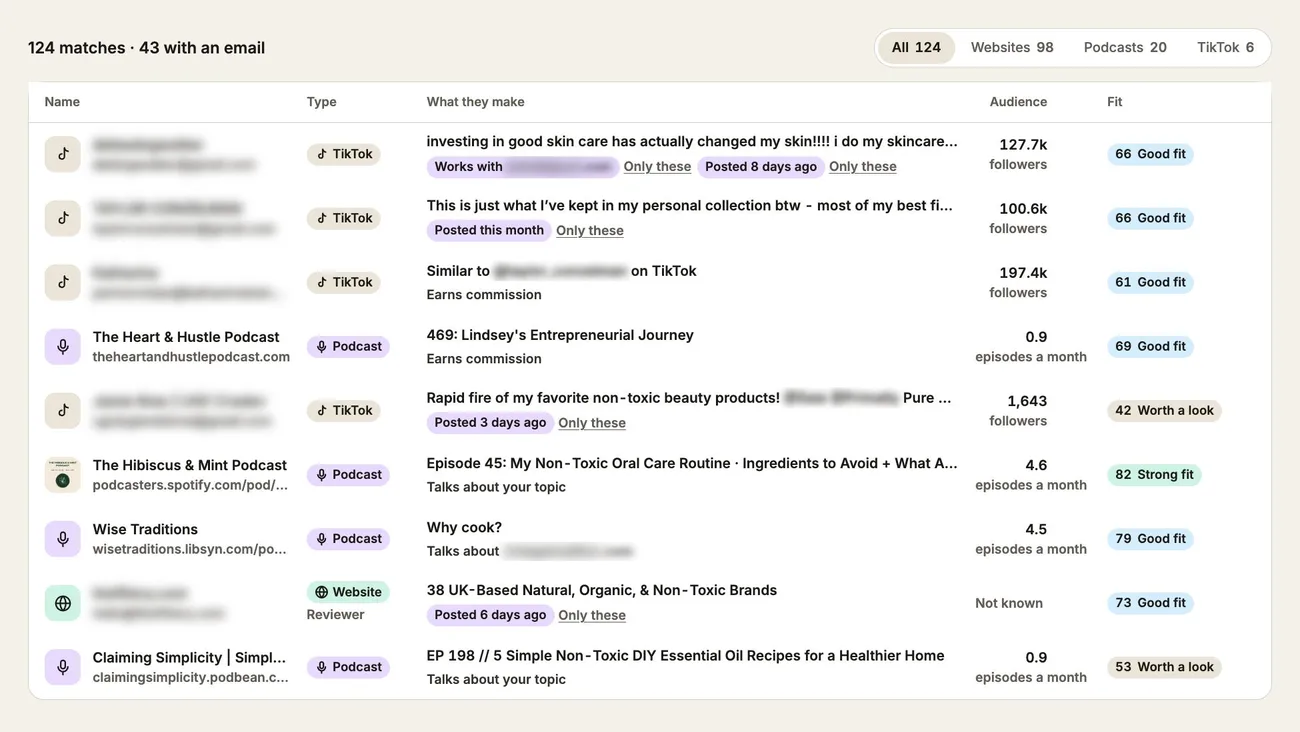
A first search lists people a brand could offer a deal to, with a fit score for each.
Try RecruitAffiliates.ai free. The 7-day trial includes 20 email lookups, and it needs no card.
Sources
- Superfiliate, types of creator partnerships (a vendor, footer dated 2022): Superfiliate guide (checked 26 October 2026)
- Lilach Bullock, nano influencer pay: Lilach Bullock page (checked 26 October 2026)
- FTC, Disclosures 101 for social media influencers: FTC page (checked 26 October 2026)
- Influencer Fee, influencer contract terms (a vendor): contract guide (checked 26 October 2026)
- Our read of 168 public Shopify programs, 23 October 2026: commission rates data page