
How to find affiliates for a home and garden brand
To find affiliates for a home and garden brand, look for five kinds of people: interior bloggers, DIY and renovation creators, gardening bloggers, gardening podcasts and gift-guide writers. Search your rivals' names next to the word "review". Then email ten of them with a free sample and a clear commission. That is the plan for a home decor affiliate program, or a garden one.
An affiliate is someone who recommends your product and earns a cut of each sale they send. A commission is that cut. A roundup is a page that ranks several brands, such as "best linen bedding".
What is a home decor affiliate program?
It is a deal where you pay people a share of each sale they send to your store. The people are bloggers, creators and reviewers who show rooms and gardens.
Search for the phrase and you will mostly find lists written for bloggers and publishers, meaning sites that earn from links. Skimlinks' page is aimed at publishers (Skimlinks, undated, checked 26 October 2026). UpPromote, an affiliate app vendor, lists 46 programs mainly for bloggers and creators (UpPromote, updated 24 June 2026).
This guide is for the brand. It covers who to ask, how to find them and what to offer. The same plan fits home decor and homeware brands, and garden brands.
Who promotes home decor and garden brands?
Home and garden is a wide field. A rug brand and a seed company reach different people. These five groups cover most of it.
| Who | What they publish | Where to look |
|---|---|---|
| Interior bloggers | Room tours and styled photos with products linked | Google: "[room] makeover" |
| DIY and renovation creators | Before and after projects, with a list of what they bought | YouTube and blogs |
| Gardening bloggers | Plant guides and "best tools" posts | Google: "best [item] for [garden task]" |
| Gardening podcasts | Interviews and tips for growers | Podcast apps, searched by topic |
| Gift-guide and roundup writers | Lists such as "best gifts for new homeowners" | Google: "[item] gift guide" |
You can set rules for who joins, for example no coupon sites. Instagram and TikTok creators cover home decor too, but they were under 1% of the people our scan showed.
Our scan found a wide spread of blog-style pages
On 22 October 2026 we ran a first search on six public Shopify home and garden brands, three UK and three US. A typical brand showed 92 people, from 35 to 160. A median is the middle brand when you line the six up from smallest to largest. Here is who they were.
| Type of page | Median per brand | Range |
|---|---|---|
| Review or roundup page | 63.5 | 26 to 90 |
| Blog-style page | 11.5 | 0 to 83 |
| Podcast | 13.5 | 1 to 33 |
| All people shown | 92 | 35 to 160 |
An email was found for 178 of the 608 people shown (29%). Those addresses were found, not checked. The product checks each one when you look it up. TikTok, Instagram and newsletters made up under 1% of the people shown.
Blog-style pages had the widest spread. These are people whose best page is a blog post. One brand showed none. Another showed 83, the most of any brand in all 30 scans. The median was 11.5, the average of the two middle brands (8 and 15). Podcasts had a narrower spread.
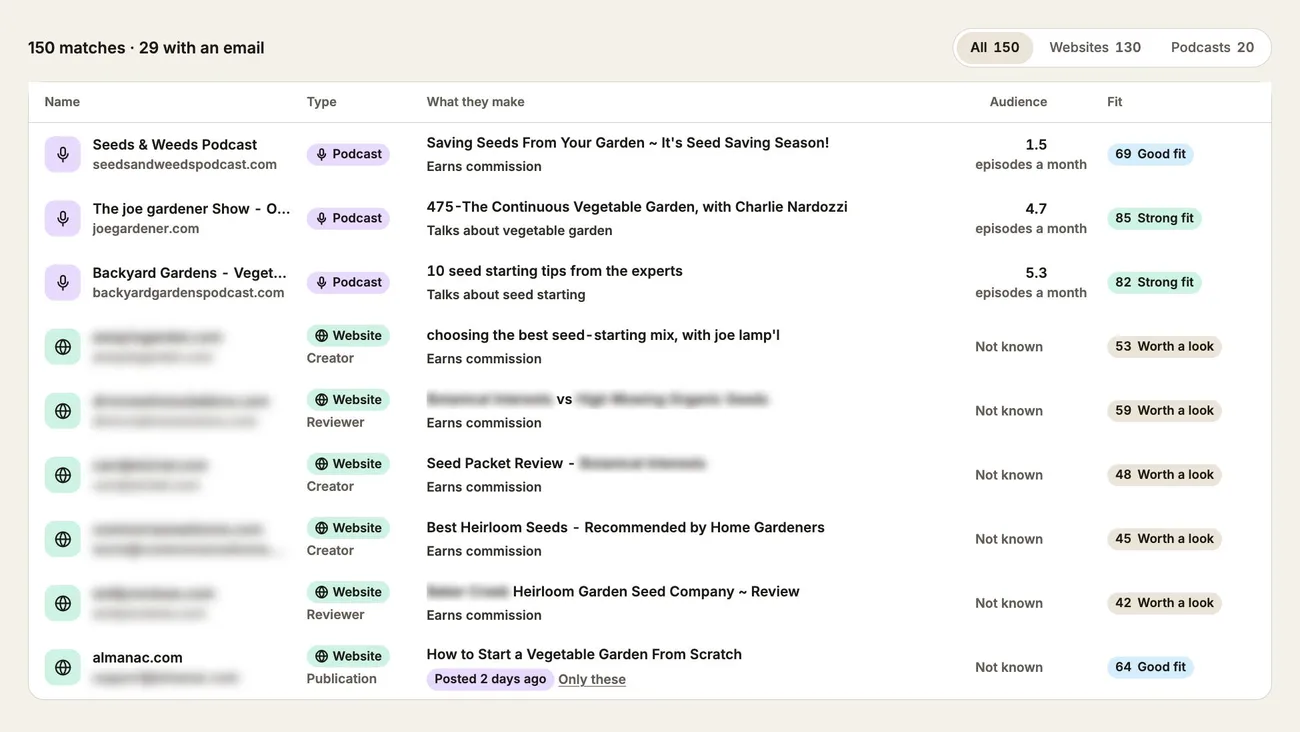
What does that mean for you? Don't assume a pile of garden bloggers is waiting. A narrow product could have few, though the scan can't tell us why. If that happens, lean on podcasts and roundup writers instead. Our page on affiliates for homeware brands has a shortlist.
Not everyone shown is a promoter. We checked 30 random rows across all 30 scanned brands, from five categories including home and garden. Nine were not promoters (30%, likely range 17% to 48%). So read the counts as an upper limit. The sample is six hand-picked brands, searched once (how we scanned). The full counts are on who promotes home and garden brands.
Where to find them by hand
Start with free steps.
- Your customers. Search your brand name and tagged posts. A person who already shows your lamp or planter in a photo is the warmest lead you have.
- Rival names. Search each rival's name next to "review" and "discount code". Note the writers whose pages come up. Our guide to finding your competitors' affiliates has the steps.
- Room and project searches. Try "small bedroom makeover" or "raised bed ideas". Open each result and note who wrote it.
- Gift guides. Search "[your item] gift guide".
- Podcasts and shows. Search your topic in a podcast app, such as "container gardening". Our guide to podcast and review-site affiliates explains how to approach hosts.
Then look for an email on each person's site. Doing this by hand takes time for a list of fifty. Our guide to finding affiliates for a Shopify store shows the full routine.
What to offer
Offer a free item to style or grow, plus a commission if they post.
- A sample. Bulky goods cost real money to ship, so check the weight first. A small best-seller is often the smarter gift.
- A commission. Of the 168 public Shopify programs we read on 23 October 2026, 14 of the 17 home and garden programs stated a base rate. The middle rate was 10%, and the middle half ran from 8% to 18.5% (what 168 Shopify programs state). The base rate is the lowest rate a program promises. Only programs that publish a rate are counted.
These are rates on a page, not what brands pay in practice. For more, read what to offer affiliates.
You also need a way to track sales for each person. An affiliate app does that, and our guide to affiliate platforms for consumer brands compares them.
The rules to follow
- Say it was a gift or an ad (US). The US Federal Trade Commission (FTC) tells creators to disclose the relationship if they got anything of value to mention a product, and says free or discounted products count (FTC, November 2019, checked 26 October 2026). A commission is a payment, so ask every creator to mark the post.
- Same in the UK. The Advertising Standards Authority (ASA) says that when a brand gives an influencer a payment or any other incentive, the content must make clear it is advertising. It also puts affiliate commission in scope (ASA, 23 March 2023, checked 26 October 2026). Our disclosure examples give wording.
- Keep claims plain. Give creators a short list of safe things to say, such as size, material and care. This is our advice, not legal advice.
What does a 10-person start look like?
You don't need a big list to learn what works. Try this for two weeks.
- Pick ten. Choose small blogs and creators. Our suggestion is three interior or DIY writers, three gardening bloggers, two podcasts and two gift-guide writers.
- Find one real post of each. Mention it in your email. For example: "Hi Sam, I'm Alex from [brand]. Your small-bedroom makeover helped me. Could I send you a throw to try? If you like it, I can set you up with a link that earns a share of each sale."
- Send the same offer. A sample, plus a link with a commission.
- Follow up once. Wait five days.
- Record what happens. Use a sheet: sent, replied, posted, sales.
- Keep the best three. Offer them more product or a higher rate, and write to ten more.
Our guide to landing your first 10 affiliates has the full plan.
Where RecruitAffiliates.ai fits
RecruitAffiliates.ai finds the people and sends the first email.
You enter your website. It finds the websites, blogs, review sites, newsletters, podcasts, YouTube channels, and Instagram and TikTok creators already covering shops like yours. Each one comes with the page that shows the fit. It looks for each person's email and checks what it finds, so you get a verified email. AI drafts a personal first email. You approve it, and it sends from your own inbox. Replies land in that inbox.
A campaign is four emails in one thread. A new mailbox sends 5 first emails a day in week one, building to 30 at most (how sending works).
Launch is $79 a month for one brand, with a 7-day free trial and no card.
Frequently asked questions
How do I find affiliates for a home decor brand?
Search your rivals' names next to "review", look at room makeover and gift-guide pages, and check your own tagged posts. Then email each person with a sample and a clear commission.
What commission should a home and garden brand pay?
Of the 14 public home and garden programs we read that state a base rate, the middle rate was 10% and the middle half ran from 8% to 18.5%.
Are gardening bloggers worth chasing?
It depends on your product. Our six home and garden brands showed anything from 0 to 83 blog-style pages, so run a search for your own product first. If few come up, add podcasts and roundup writers.
Do UK rules differ from US rules?
The wording differs, but the idea is the same. In the US the FTC says free products count as a connection that creators should disclose. In the UK the ASA says content must make clear it is advertising when a brand gives an incentive. Ask every creator to label the post.
How do I track sales from home and garden affiliates?
Give each person a unique link or code, using an affiliate app or your store's own tools. If your store has no affiliate app yet, see our platforms guide. Count sent, posted and sales after your first two weeks.
Sources
- Skimlinks, 17 home decor affiliate programs (a publisher-facing list, undated): Skimlinks page (checked 26 October 2026)
- UpPromote, 46 home decor and furniture programs (a vendor, updated 24 June 2026): UpPromote list (checked 26 October 2026)
- ASA, updated guidance for influencer marketing (23 March 2023): ASA page (checked 26 October 2026)
- FTC, Disclosures 101 for social media influencers (November 2019): FTC page (checked 26 October 2026)
- Our first search on six home and garden brands, 22 October 2026: home and garden data page
- Our read of 168 public Shopify programs, 23 October 2026: commission rates data page