
How to find affiliates for a pet brand
To find affiliates for a pet brand, look for five kinds of people. They are pet accounts, pet owners, vets and trainers, review bloggers and rescue groups. Search pet hashtags and your rivals' names. Then email ten of them with a free sample and a clear offer. Start small, learn who replies, and widen the list.
An affiliate is someone who recommends your product and earns a cut of each sale they send. Pet influencer marketing is paying or gifting creators who talk about pets, so their followers see your product.
What is pet influencer marketing?
It means working with people whose audience loves animals. Your buyer is a pet owner, and a recommendation from another owner can carry more weight than an ad.
The numbers back up the pull of the niche. Per the American Pet Products Association, nearly two-thirds of pet owners follow at least one pet influencer. That figure comes from impact.com's guide, which cites it (impact.com, checked 26 October 2026). The same page, citing Sprout Social, says pet influencers average 5% engagement, against 1% to 3% for most influencers. Engagement is the share of followers who like, comment or share. Both are second-hand figures from a software vendor, so use them as a direction.
Who promotes pet brands?
impact.com describes three kinds of pet account. In the first, the pet is the star. In the second, owners share life with their pets. In the third, pet professionals such as vets and dog trainers mix teaching with personality. We would add two more.
| Who | Why they fit | Where to look |
|---|---|---|
| Pet accounts | The animal is the star, so a product shot looks natural | Instagram and TikTok pet hashtags |
| Pet owners | Followers see themselves in the feed | Your own customers' tagged posts |
| Vets and trainers | Followers trust their advice | YouTube, blogs and podcasts |
| Review bloggers | They write "best of" lists that buyers search for | Google: "best dog [product]" |
| Rescue groups and clubs | They reach adopters with a real need | Their newsletters and local pages |
Non-pet creators can help too. One impact.com example shows a creator promoting a stain remover with her dog in the video.
Where do I find them?
Start with free steps. A pet brand has plenty of public places to look.
- Your own customers. Search your brand name and tagged posts. People who already post your product are the warmest list you have.
- Pet hashtags. On Instagram, search tags like #dogsofinstagram and sort by recent. On TikTok, try #pettok or #dogtok. Modash lists these steps and also suggests the "suggested accounts" row on a profile (Modash, a vendor, checked 26 October 2026).
- Rival tags and names. Look at who tags brands like yours. Search each rival's name next to "review" or "discount code" and note the writers whose pages come up.
- YouTube. Search the questions your buyers ask, such as "best leash for a puller". Look at the channels that answer.
- Pet blog roundups. Search "best pet bloggers" and "best dog blogs". Some bloggers also post on Instagram or TikTok, so one good list can lead to more profiles.
Doing this by hand takes time. Our guide to finding affiliates for a Shopify store shows the full routine. The page for pet brands lists search ideas for dog and cat owners. A tool can do the first pass for you. We have not scanned pet brands, so we have no counts for them. On 22 October 2026 we ran a first search on 30 public Shopify brands in five other categories. The 30 shops were picked by hand, six in each category. It showed a median of about 92 people per brand, and for 916 of the 2,924 people shown (31%) it found an email address. The addresses were found, not checked. That gives you a sense of scale, not a pet figure. See our scan of 30 Shopify brands for the method and limits.
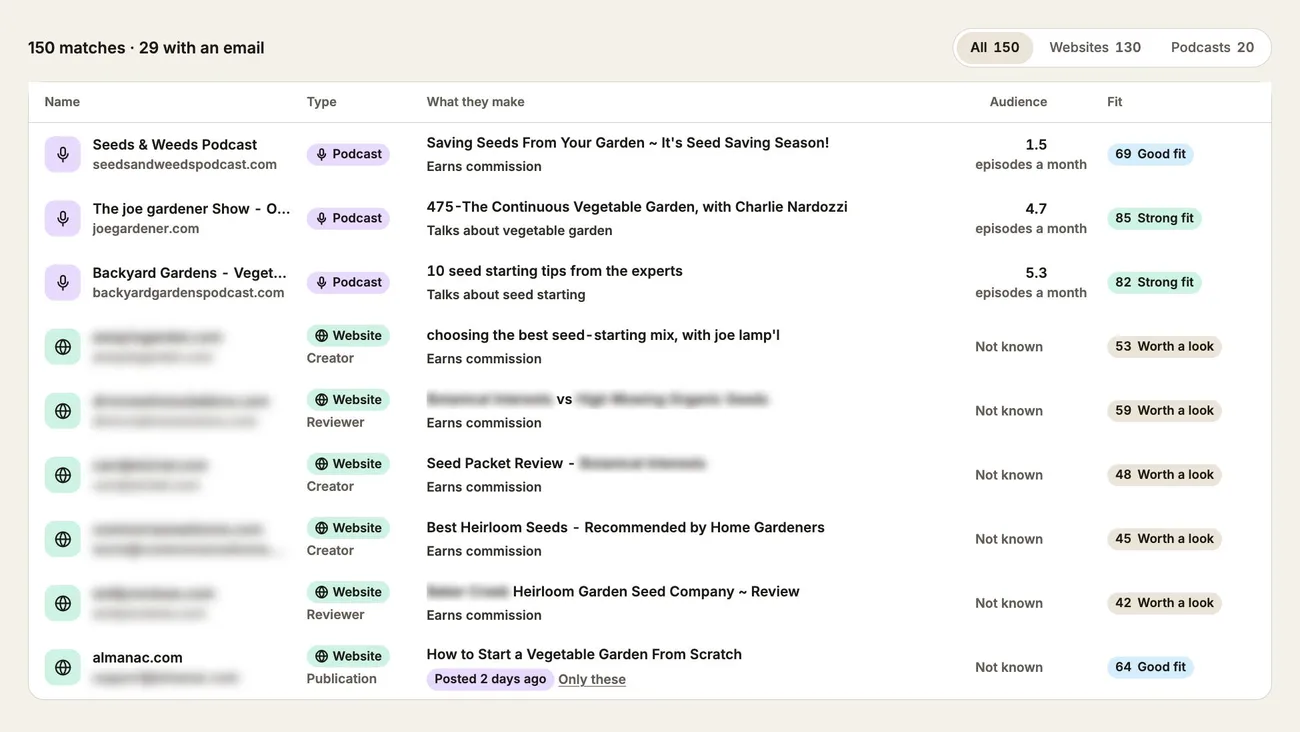
How do I tell a good account from a bad one? Modash advises you to compare engagement with follower count, read the comments for real conversation, and confirm the audience lives in the countries you sell to. It also says to run a fake-follower check before you pay.
What should I offer?
Start with a free sample, then offer commission to those who post.
- A gift. Send one product with a short note. A pet creator can try it with a real animal. Shipping costs add up, so check the weight first.
- A commission. If a creator posts, offer a link or a code with a rate. Of 168 public Shopify programs we read on 23 October 2026, 137 stated a base rate, which is the lowest rate a program promises. The middle rate was 10% (what commission a Shopify program should pay).
What do dog brands pay? Public rates vary. UpPromote, an affiliate app vendor, lists 21 dog-product programs in a roundup (last updated 24 June 2026). We counted its table by hand. We found no cat or other-pet list, so these are dog figures. A cookie window is how many days after a click a sale still counts.
| What we counted | Result |
|---|---|
| Programs listed | 21 |
| Pay a percentage | 14 |
| Pay a flat dollar sum per referred customer | 7, from $5 to $80 |
| Percentage rates, leaving out one 75% digital course | 13: 2, 3, 4, 9, 10, 10, 10, 10, 10, 12, 15, 20, 20 |
| Middle rate (the median) | 10% |
| State a cookie window | 16 |
| Of those, say 30 days | 12 |
Source: UpPromote, checked 26 October 2026. The page lists one brand, West Paw, at 10% in its table and 20% in its text. The middle rate is 10% either way. These are rates on a page, not what brands pay in practice.
Pet creators may charge for posts. One vendor page puts the average pet influencer post at $1,719 over March 2024 to 2025 (impact.com, citing Sprout Social). The page does not say how big these accounts are. Averages are pulled up by large accounts, so small creators likely charge less. One UK guide says a lot of work by very small creators is paid in product alone (Lilach Bullock, one writer's view, checked 26 October 2026).
Two rules to follow
- Say it was a gift or an ad. In the US, the Federal Trade Commission (FTC) treats "free or discounted products" as a "material connection". That is a link between brand and creator that readers should know about (FTC, checked 26 October 2026). The page also names a brand paying the creator as a material connection. A commission is a payment, so ask every creator to mark the post as an ad or a gift. The page does not name commission.
- Keep claims to what you can prove. Don't let a post say your treat cures an illness. Give creators a short list of safe things to say, such as the ingredients and the size range. This is our advice, not legal advice. If your product makes health claims, check the rules where you sell.
Also watch how animals are treated on camera. A creator who stresses a pet for a clip will hurt your name.
What does a 10-person start look like?
You don't need a big list to learn what works. Try this for two weeks.
- Pick ten. Our suggestion is people with 1,000 to 25,000 followers, or small blogs. Two should be vets or trainers. Two should be review bloggers. Six should be owners or pet accounts.
- Find one real post of each. Note something you liked, to open your email. For example: "Hi Sam, I'm Alex from [brand]. I liked your video on loose-leash walking. Could I send you a leash to try? If you like it, I can set you up with a link that earns a share of each sale."
- Send the same offer. A free sample, plus a link with commission if they post.
- Follow up once. Wait five days.
- Record what happens. Use a sheet: sent, replied, posted, sales.
- Keep the best three. Offer them more product or a higher rate, and write to ten more. Add rescue groups at this stage.
Our guide to landing your first 10 affiliates has the full plan.
Frequently asked questions
How do pet brands find influencers?
They search pet hashtags, their rivals' tagged posts and review blogs, and they ask their own customers. Then they email each person with a sample and a clear offer.
What do pet influencers charge?
It varies a lot. One vendor page cites an average of $1,719 a post across pet influencers. It does not say how large they are, so small creators likely charge less. One UK guide says a lot of small-creator work is paid in product alone.
Do pet brands run affiliate programs?
Yes. UpPromote's roundup lists 21 dog-product programs, and 12 of the 16 that state a cookie window say 30 days. We found no list for cats or other pets.
How do I find pet bloggers?
Search Google for "best dog blogs" or "best [your product]" and read who writes the roundups. Search your rivals' names next to "review". Some bloggers also post on Instagram or TikTok.
Find the people who already cover pet brands
Try RecruitAffiliates.ai free. The 7-day trial includes 20 email lookups, and it needs no card.
Sources
- impact.com, pet influencer marketing (undated; cites the American Pet Products Association and Sprout Social): impact.com guide (checked 26 October 2026)
- Modash, how to find pet influencers (vendor; undated): Modash guide (checked 26 October 2026)
- UpPromote, dog affiliate programs (a vendor, updated 24 June 2026): UpPromote roundup (checked 26 October 2026)
- FTC, Disclosures 101 for social media influencers: FTC page (checked 26 October 2026)
- Our read of 168 public Shopify programs, 23 October 2026: commission rates data page
- Our first search on 30 public Shopify brands, 22 October 2026: study page