
How to find influencers on Instagram for a small brand
An influencer is a person with an audience that trusts their taste. To find them on Instagram for a small brand, run these searches by hand. Search topic words. Open hashtag pages. Check places. Read the tagged posts on your rivals' profiles, then on your own. Last, skim a rival's followers. Write each good account in a sheet. Twenty rows is a fair first list.
This page covers the searching only. It doesn't cover how to find their email or what to offer. Those have their own guides, linked at the end.
Where to look on Instagram
Start in the search bar and try each search below. The table shows what each one gives you and where it falls short. The "falls short" column is our own advice from using these searches, not an Instagram rule.
| Search | What to open | What you get | Where it falls short |
|---|---|---|---|
| Topic words | Type what a buyer would, such as night cream review | Accounts and posts that match the words | Results are ranked, so you see a sample, not every match |
| Hashtags | Open the Tags tab, then a hashtag | Top and recent posts using that tag | Big tags bury small accounts under older, larger ones |
| Places | Search a town or a shop area | Geotagged posts near you | Only useful if you sell locally or want local people |
| Your rivals' tagged posts | A rival's profile, then its Tagged tab | Real people who posted about a rival's product | Rivals with few customers have little to read |
| Your own tagged posts | Your profile, then its Tagged tab | People who already like you | A short list for a new brand |
| A rival's followers | The followers list of a public rival | A rough pool of people near your niche | Mostly customers, not promoters. Slow. |
Instagram says each part of the app uses its own algorithm, built for how people use that part. It also says it personalises everyone's experience (Instagram, how Instagram ranking works, 31 May 2023, checked 28 October 2026). In our view, that means the first screen of results is a sample, not a full list.
Instagram is worth the effort. A Pew Research Center survey from 30 January to 18 June 2026 found 51% of US adults use it, and 79% of those aged 18 to 29 (Pew Research Center, social media fact sheet, published 19 October 2026, checked 28 October 2026).
Tab names and order change by app version and account, so look for the closest match on your own phone.
Searching with topic words and hashtags
Say you sell a gentle night cream. Search the words a buyer would type, then the tags a creator would use.
- Type
night cream review,skincare routineanddry skin tipsinto the search bar. - Open the Accounts tab and scroll for people who post about products like yours, not just stock photos.
- Open the Tags tab. Pick two or three tags and look at both the top and recent posts.
- Add every account that looks right to your sheet. Don't message anyone yet.
Pick narrow tags over wide ones. #nightcreamreview shows fewer, closer posts than #skincare, which has millions of them. A narrow tag is also where smaller accounts show up.
Look at the tags a creator chose, as well as the ones you searched. A few chosen tags say who a post is for. This is our advice from using the search, not an Instagram rule.
For the wider idea of what a small creator is, read what a micro-influencer is and how to find micro-influencers across all platforms.
Using tagged posts
Tagged posts are worth trying first. In our view they suit a small brand best, because each one is a real person who already made something about a product like yours.
Open a rival's public profile and find its Tagged tab. Read the first 20 posts. Note any account that made a post about the product itself. A like or a one-line comment is too weak to count.
Then do the same on your own profile. These people already know you, so a thank-you and an offer is an easy first message.
Last, open one good account you've found and look at who it tags and who it posts with. In our experience, creators in one niche often tag each other. That can turn one good account into five.
Read a rival's followers last
The followers list of a rival is mostly buyers and window shoppers. Few of them promote anything.
If you try it, look only for accounts whose bio names a topic, such as "skincare notes" or "plant-based baking". Skip accounts with no posts or a private lock. If the list won't open or stops after a few hundred names, move on. The tagged posts are the better source.
What did our scan find on Instagram?
On 22 October 2026 we ran RecruitAffiliates.ai's normal first search for 30 public Shopify brands, six in each of five categories. It showed 2,924 people in all. Instagram gave 17 of them. Only seven of the 30 shops had any Instagram result. Nine came from one fashion shop and five from three beauty shops (the scan data).
Treat 17 as a floor. One brand's Instagram search ran out of time, and Instagram data comes mostly from a lookup service. The scan counts people, not sales, and it ran once on one day. See the method and limits. In the same scan, 1,877 people (64%) had a review, roundup or comparison page as their best evidence.
Here is how the 17 Instagram people split across the five shop types in that scan. These are counts only, from the scan data.
| Shop type | Shops | People shown | Instagram people | Shops with any |
|---|---|---|---|---|
| Fashion and apparel | 6 | 457 | 9 | 1 |
| Beauty and skincare | 6 | 620 | 5 | 3 |
| Health and supplements | 6 | 715 | 1 | 1 |
| Fitness and sports | 6 | 524 | 1 | 1 |
| Home and garden | 6 | 608 | 1 | 1 |
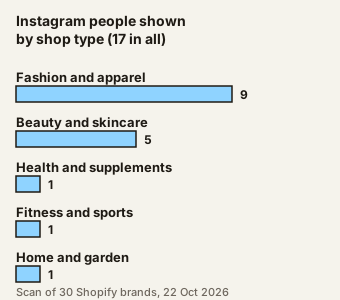
Instagram only showed up in a handful of shops, and mostly in fashion and beauty. Our tool's Instagram data was thin in this run. That does not show Instagram is weak. If you sell something visual and worn or applied, the app is still worth your hand search.
What this means for you:
- Search Instagram by hand too. RecruitAffiliates.ai's Instagram list is thin, so your own search in the Instagram app fills the gap, and the tagged posts are free.
- Treat Instagram as one source. Start with the writers and reviewers who already cover your kind of product, then add a small batch of creators. Our guide to finding affiliates on Instagram covers what to do once you've found them.
How do you check an account before you add it?
Spend two minutes on each profile. Look for four things.
- Real comments. Replies that talk about the post, not strings of emoji.
- Fit. Recent posts match your buyer and show products like yours.
- Engagement over size. Compare likes and comments with followers. Be wary of a big account with few likes and comments that are all single emoji. That is our rule of thumb, not a measured cutoff.
- A way to reach them. An email or a link to a site in the bio.
Small accounts are fine. Nano influencers have the smallest audiences, so read that guide before you rule them out.
Keep the list in one sheet
Use one sheet, one row per account. Write down five things.
| Column | Example |
|---|---|
| Handle | @samsnightroutine |
| The post that caught your eye | The 3-step night routine Reel |
| Where you found it | #nightcreamreview, top tab |
| Where to reach them | Email in bio |
| Date you wrote to them | 29 October |
Stop at 20 rows for the first round. Write to a few at a time and see who replies before you go further.
What to do with the list
Searching by hand gets you the names. It takes time, and the list stops at what the app shows you. A tool can cover the other places people write. Three guides pick it up from here.
- To get an address, read how to find an email for a creator.
- To write to them, use the influencer outreach email template.
- For tools that build a list for you, see tools to find influencers.
If you ask for a post in return for a free item or a commission, ask them to say so. The US Federal Trade Commission says a free product or payment is a material connection to disclose (FTC influencer disclosures guide, checked 28 October 2026). Our affiliate disclosure examples give wording to copy.
Where RecruitAffiliates.ai fits
RecruitAffiliates.ai does the searching for you. You enter your website. It finds the people already covering shops like yours: websites, blogs, review sites, newsletters, podcasts, YouTube channels, and Instagram and TikTok creators. Each comes with the page that shows why it fits.
It looks for each person's email and checks it, so you get a verified email. AI drafts the first email. You approve it, and it sends from your own inbox. It doesn't message anyone on Instagram for you.
Launch is $79 a month for one brand, with a 7-day free trial and no card. The Shopify page has the five steps.
Frequently asked questions
How do I find influencers on Instagram for free?
Search topic words and hashtags in the app, read the tagged posts on your rivals' profiles and your own, and keep a sheet. It costs time, not money.
Which hashtags should a small brand use to search?
Narrow ones that name the product and the need, such as #nightcreamreview. Wide tags such as #skincare bury small accounts.
How many accounts should I list first?
Twenty. That's enough to learn who replies without spending a week on research.
Is the followers list of a rival worth reading?
Rarely. It's mostly buyers, not promoters. Tagged posts are a better source.
Can Instagram show me every influencer in my niche?
No. Instagram ranks what each part of the app shows and personalises it, so you only see a sample (Instagram, checked 28 October 2026).
Sources
- Instagram, how Instagram ranking works, 31 May 2023, checked 28 October 2026
- Pew Research Center, social media fact sheet, published 19 October 2026, checked 28 October 2026
- US Federal Trade Commission, Disclosures 101 for social media influencers, checked 28 October 2026
- RecruitAffiliates.ai, Shopify affiliate scan: method and counts, 22 October 2026