
Newsletter sponsorship or affiliates for a small brand
Ask one thing first: can you afford to lose the fee? For a small brand weighing newsletter advertising, an affiliate deal is the lower-risk start. You pay a commission only after a sale. A newsletter sponsorship is a flat fee you pay for a slot in someone's email. It wins when you need a fixed date and a known audience size. You can also try both. Start with whichever fits your cash.
An affiliate is someone with an audience who sends you buyers and earns a commission, a cut of each sale. This guide compares the two options side by side and shows when each one wins. It ends with a two-part test with up to $100 at risk. We make software that finds affiliates, so weigh our view with that in mind.
What are the two options?
Sponsorship. A flat fee is a set price that does not change with results. You pay it for a slot, and your ad runs in one or more issues. Many newsletters publish a rate card, which is a price list for their ad slots. A slot is one place in an issue where an ad can run. You can lose money if nobody buys.
Affiliate. You give the newsletter owner a link or code and a commission. They write about you, and you pay only when someone buys. The owner may say no, because a sale is not guaranteed for them either.
Many sponsorship prices come from a CPM, short for cost per thousand. It is what you pay for each thousand subscribers who get the email. Beehiiv, a newsletter platform, gives the formula: sponsorship cost, divided by subscribers, times one thousand. Its guide says CPMs typically run from $10 to $75. For small lists (under five thousand subscribers) it says to expect $50 to $250 per slot (Beehiiv's guide, published 9 November 2025, checked 26 October 2026). Beehiiv sells newsletter software, so treat those as a guide. Every price source here is a seller or reports seller data, and we found no independent one.
Prices also vary a lot by topic. A trade report on one marketplace's data puts human resources newsletters at $18.47 per thousand subscribers and lifestyle ones at $1.22. It does not use the CPM unit, so the two may not compare (PPC Land on Paved, 30 August 2026, checked 26 October 2026).
Big lists cost more in total but can cost less per thousand. Snopes sells those ads. Its public rate brief lists $10,000 for one send to a list of just over a million. That is a $9.91 effective CPM, meaning the real cost per thousand (Snopes' partnership brief, Q3 2026, checked 26 October 2026). It says to compare on "cost-per-engaged-reader, not raw CPM."
How do they compare side by side?
| Factor | Sponsorship | Affiliate |
|---|---|---|
| What you pay | A flat fee up front | A commission after each sale |
| Cash needed first | Yes, the full fee | None, apart from any sample or discount |
| Risk | You can pay and get no sales | You pay only when someone buys |
| Speed | Faster, once you agree a date | Slower, as the owner has to agree first |
| Tracking | Needs a link or code you set up | Link or code is part of the deal |
| Control | You often supply the ad text | The owner writes it in their own voice |
| Who says yes | Owners who sell slots, in our view | Owners who like your product |
The big difference is who carries the risk. In a sponsorship, you do. In an affiliate deal, you share it with the owner.
Sponsorship wins when
Pick sponsorship when one of these is true.
- You need a fixed date, such as a launch day or a sale.
- You want to know the reach first. A rate card, when there is one, names the list size.
- The owner only sells slots and takes no affiliate deals.
- You have cash and a product that sells well on first sight.
Sponsorship also lets you write the message. That helps when your product needs careful wording.
Affiliates win when
Pick affiliates when these hold.
- Cash is tight. You can't afford to lose a flat fee.
- Your product needs trust. A reader who hears "I use this" from an owner they follow may act on it.
- You want a long relationship. In our view, some deals can keep paying the owner as long as sales come.
- You can track sales, with a link or code per owner.
Public Shopify programs state a median base commission of 10% (our reading of 168 programs). Our guide on what to offer affiliates covers the commission. The free affiliate calculator shows how many people to ask for a sales goal.
Here is an example, not a result. At the 10% median, a $50 order pays the owner $5. A $100 slot would need 20 such orders to match that spend. An affiliate deal pays $5 on each $50 order, from the first one. A code that takes money off adds to that cost. This example compares only what you pay. It does not say how many orders each route brings.
Setting up an affiliate deal costs nothing, apart from any discount or sample. Shopify lets you create percentage discount codes (Shopify Help Center, checked 26 October 2026). Make one code per owner, and add a link with a tracking tag if your store supports it.
What did our scan show about newsletters?
Almost nothing. We ran our software's first search on 30 public Shopify brands on 22 October 2026. It showed 2,924 people, and 9 were labelled newsletters by a rough rule nobody checked by hand. The search has no newsletter step, so those 9 say nothing about how many newsletters exist. The scan method and limits page gives the 9, and the per-shop CSV has a newsletter column for each shop.
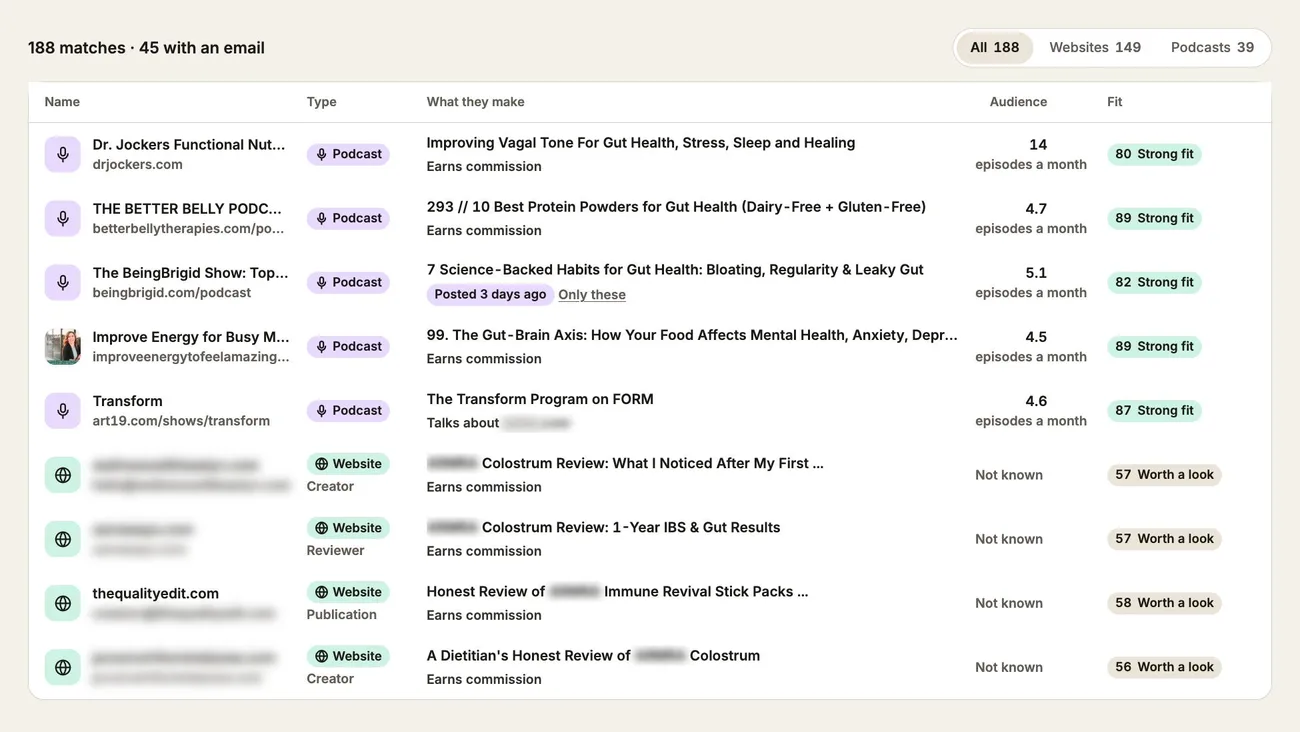
So treat newsletters as one channel among several. Look at them alongside blogs, review sites and podcasts. Our guide on finding podcast and review site affiliates covers two of those. Where to find affiliate partners walks through every channel.
How do you find newsletters to approach?
Look for newsletters your buyers already read.
- Ask your customers which emails they read about your topic.
- Search your topic plus "newsletter" and "sponsor", and check each result's "advertise" or "sponsor" page.
- Look at your rivals. Search a rival's name inside newsletter archives, or check who mentions them.
- Read two or three issues of each. Is it about your kind of product? Are links in the body or only in ads?
- Find the contact. Many owners list an email on an "advertise" page or in the footer.
If you sell software to businesses, the same steps apply. Newsletters aimed at your buyers' job or industry often sell sponsor slots. Some sell slots only, so expect some refusals when you offer an affiliate deal.
How do you start small?
Set aside $200. Spend up to $100 on one slot and keep $100 in reserve. Split it so you learn something about both options. This is one way, not a rule. Two different newsletters are not a fair like-for-like test, so a few sales is a hint, not proof.
- Pick two small newsletters in your niche. Check the rate card, or ask for one.
- Sponsor one with up to $100. At Beehiiv's formula, $100 at a $25 CPM buys a slot on a 4,000-subscriber list. That $25 is an example, not a quote.
- Offer the other an affiliate deal. Send a link, a code and a commission. That costs nothing until a sale, apart from any discount or sample.
- Use a separate link or code for each, so you can see which one sold.
- Hold the other $100 until you see results from both. If the sponsor slot won, buy a second one. If the affiliate deal won, offer a higher commission or a free product.
After a few weeks, compare cost per sale, which is the money you spent divided by the sales you got. An affiliate deal with no sales has not won, even though it cost nothing. Repeat with the one that did better.
What should you disclose?
Readers should know when a mention is paid or comes with a commission. The US Federal Trade Commission describes a "material connection" as a financial relationship. Its example is "the brand paying you or giving you free or discounted products or services" (FTC, Disclosures 101 for Social Media Influencers, November 2019, checked 26 October 2026). That guide is written for influencers, and it does not name newsletters. In our view the same idea applies to a sponsor slot and to an affiliate link. Ask the owner how they will label it, and check the rules for the places you sell to.
How do you write to the owner?
Write to them as a person. Keep it to three parts.
- An issue you read. Name it and say what you liked.
- What you sell. Say it in one line.
- Your offer in numbers. Give the slot price you would pay or the commission you would offer.
Our affiliate recruitment email guide has a worked example you can adapt.
Frequently asked questions
How much does newsletter advertising cost?
It depends on list size and niche. Beehiiv's guide says CPMs typically run from $10 to $75, and $50 to $250 per slot for lists under 5,000. Large lists cost more in total, though the CPM can be lower. A rate card is the best source, so ask each newsletter for theirs.
Do newsletter affiliates work?
We have no data on newsletter affiliate results. They can work when the newsletter's readers match your buyers and the owner likes your product. You pay only on sales, so the cost of a miss is small. Use a separate link or code so you can see what each newsletter sold.
How do I find newsletters to sponsor?
Ask your customers what they read, then search your topic plus "newsletter" and "sponsor". Read a few issues before you pay. Check each one is about your kind of product, and note who to write to.
Is it better to pay a flat fee?
For a small brand with little cash, often not, in our view. A flat fee needs cash up front and carries all the risk. It is better when you need a fixed date or a known reach. You can test one of each.
Sources
- Beehiiv, Newsletter sponsorship cost: CPM range, formula and small-list rates (published 9 November 2025, checked 26 October 2026)
- Snopes, Partnership Brief, Q3 2026: a $10,000 send to a list of just over a million, $9.91 effective CPM (checked 26 October 2026)
- Our scan of 30 Shopify brands, 22 October 2026: method, counts and limits and the per-shop CSV
- PPC Land, Paved finds HR newsletter ad rates run 15 times higher than lifestyle lists (30 August 2026, checked 26 October 2026)
- Shopify Help Center, discounts (percentage discount codes, checked 26 October 2026)
- US Federal Trade Commission, Disclosures 101 for Social Media Influencers (November 2019, checked 26 October 2026)
- We found no independent source for newsletter prices. Use the seller figures above as a guide, and ask each newsletter for its rate card.