
How to find affiliates for a supplement brand
A supplement affiliate program starts with the right people. To find affiliates for a supplement brand, put active podcast hosts on your first list. Add the people behind review and roundup pages, health blogs, YouTube channels and newsletters. Podcasts stand out in this category. Email ten people with a clear offer and a short list of what they can say.
An affiliate is someone who recommends your product and earns a cut of each sale they send. A supplement affiliate program is your offer to those people. It has a link or code, a commission rate, and the rules. Below you'll find who to ask, where to look and what to offer. You'll also find the US and UK rules on health claims and ad labels.
Who promotes supplement brands?
Supplement buyers often want an explanation before they buy. So hosts and reviewers who explain things tend to fit better than accounts that post fast photos.
| Who | Why they fit | Where to look |
|---|---|---|
| Podcast hosts | Listeners hear a topic discussed at length, then a code | Podcast search, plus episode titles on your topic |
| Review and roundup writers | They rank "best magnesium" or "best greens" pages that buyers search for | Google: "best [your product type]" |
| Health and wellness bloggers | They write long guides and mention products inside them | Blogs that name your rivals |
| YouTube channels | Viewers watch a routine and see what is in it | YouTube search for your main topic |
| Newsletter writers | They email a small, loyal list | Newsletter pages that link to rivals |
A dietitian or personal trainer can sit in any row. Credentials help trust. They also raise the stakes on what that person says about health, so brief them first (see the rules below).
Why put podcasts on your first list?
Podcasts aren't the biggest group for supplement brands. They're where this category stands out. Fashion brands showed a median of 2 podcasts. Supplement brands showed 28.5.
We ran a first search on six public Shopify health and supplement brands on 22 October 2026. It showed a median of 126 people per brand. In a hand check of 30 rows from all five categories, about 3 in 10 weren't promoters. The likely range was 17% to 48%. So expect roughly 7 in 10 of the people shown to be real prospects. Only 5 of the 30 rows were supplement rows, so treat that as a rough guide.
A median is the middle value when you sort the six brands. With six, it sits halfway between the third and fourth. A roundup is a page that ranks several brands, such as "best magnesium supplements". Review and roundup pages were the biggest group, at 55% of people shown. Blog-style pages were 24%. Podcasts came third, at 20%, the highest podcast share of the five brand categories we scanned.
The podcast counts for the six brands were 1, 8, 18, 39, 40 and 40. The middle two give a median of 28.5. Across the other four categories, the podcast medians ran from 2 (fashion) to 13.5 (home and garden). The supplement data page has the full counts, and our category comparison shows all five.
So the median describes none of the six. We grouped the brands after the fact, and the topics we typed differ between the groups.
| Topics we typed | Brands | Podcasts shown per brand |
|---|---|---|
| Menopause, hormone balance, colostrum, gut health | 3 | 40, 40, 39 |
| Vitamins and magnesium, algae, plant protein | 3 | 8, 1, 18 |
The topics may explain the gap. We can't prove that with six brands. Test your own. Some podcast rows may also be directory pages, because the search labels a result from its page type and address.
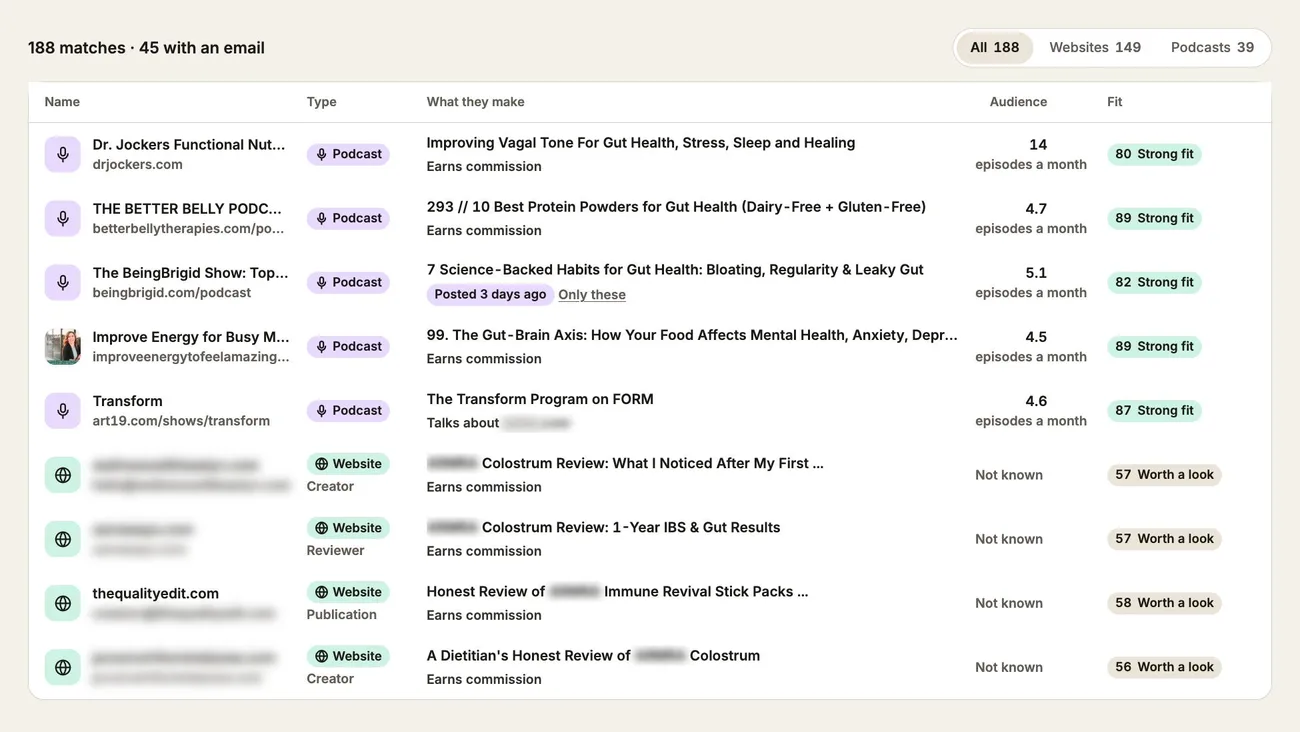
Here's why we still put podcasts on the first list. This is our reasoning, and it isn't scan data. Podcasts are fewer than roundup pages. They are easier to judge, because you can listen to what a host says about products. A host who already reads out a rival's code has shown they take sponsors and codes. A podcast also has a clear contact point. In our view, the show's own site often lists a booking or sponsor address.
Where do I look for supplement affiliates?
Start free. Keep a sheet with one row per person. Note where you found them.
- Pick your topics. Write the three things your buyers search for. A greens powder might use "gut health", "energy without coffee" and "greens powder". Brands in our scan varied a lot, and the topics we typed may be part of why. So pick them with care.
- Search podcasts by topic. Search each topic in a directory such as Listen Notes, Apple Podcasts or Spotify. Open the last five episode titles. Keep shows that discuss products and routines.
- Search your rivals' names. Try "[rival] review", "[rival] discount code" and "[rival] podcast". Note who writes the pages and who reads the codes.
- Read the roundups. Search "best [product type]" and list the writers behind the first ten results. Our guide to finding podcast and review-site affiliates covers how to check each one is active.
- Check each person's claims. Skim a few pages. If someone says a supplement cures a disease, skip them. You'll be held to what they say (see below).
The full routine for any Shopify shop is in how to find affiliates for your Shopify store. Our page for supplement brands lists search ideas by product type.
What should I offer?
Offer four things:
- A code that gives their audience a discount.
- A tracked link, so each sale is counted.
- A commission on each sale.
- A trial size, which is free product. The ad label should mention it.
In our view, a code and a link both help. A code works on a podcast, where nobody can click. A link works in writing. A trial size is a good way to start. People judge a daily product best by trying it.
How much to pay is your call, and there is no single right rate. Of the supplement programs we read in October 2026, 22 stated a base rate. The base rate is the lowest rate a program promises. The median was 10%, and the middle half stated 10% to 15%. Those are rates on a page, not what brands pay in practice (commission data, 23 October 2026). For how to set yours, read what commission a Shopify program should pay.
What are the rules on health claims and ad labels?
Health claims carry legal risk for supplements. This isn't legal advice. Check the rules where you sell, and talk to a lawyer about your own labels and claims.
In the US, federal rules bar disease claims for products sold as dietary supplements. Examples are claims to treat, cure or prevent a disease. A claim about how a nutrient affects the body's structure or function is allowed. It needs the FDA's disclaimer on the label. The maker must also tell the FDA. That is due within 30 days of first selling the product with the claim (21 CFR 101.93, current to 23 October 2026 and checked 26 October 2026).
The Federal Trade Commission (FTC) says health claims need proof. Its guidance calls randomized, controlled human clinical trials the most reliable evidence. It also says advertisers are liable for the misleading use of endorsements. An honest opinion from the endorser isn't enough (FTC, Health Products Compliance Guidance, checked 26 October 2026).
On affiliate disclosure, the FTC's endorsement Q&A wants a clear disclosure close to the recommendation. "Paid link" next to an affiliate link should be adequate. "Commissionable link" probably isn't. Your company is ultimately responsible for what others do on your behalf. You also need a reasonable program to train and monitor your network (FTC, Endorsement Guides: What People Are Asking, checked 26 October 2026).
In the UK, the Advertising Standards Authority (ASA) treats supplements as food. Medicinal claims for food are prohibited. Only claims authorised on the Great Britain nutrition and health claims register may appear in ads (ASA, supplements advice, 11 January 2024, checked 26 October 2026). For sports products, weight loss, fat burning and muscle gain claims count as health claims too (ASA, sports supplements, 16 September 2025, checked 26 October 2026).
On affiliates, the ASA says affiliate links are always likely to count as advertising. "Aff" on its own may not be understood, so it suggests a plain "Ad" label. Brand and affiliate are jointly responsible (ASA, affiliate marketing, 10 October 2024, checked 26 October 2026).
What this means in practice:
- Give every affiliate a one-page brief. List what they may say, such as what is in the product. List what they may not say, such as that it treats or cures a disease.
- Ask for a clear ad label on every post, show or video. Our post on disclosure wording has examples.
- Spot-check. Read a few posts after launch. It takes a few minutes. If one breaks the brief, ask for a fix the same day.
What does a 10-person start look like?
Keep it small. Try this over two weeks.
- Pick ten. Aim for four podcast hosts, three roundup or review writers and three health bloggers or YouTube channels. If your topic search shows fewer than about five active shows, give those slots to roundup writers. Choose people whose recent work covers your topic.
- Open with something real. Name an episode or post you liked. Say what you sell in one line. Add a free trial size and a code with a commission.
- Keep claims out of the email. For example: "Hi Sam, I liked your episode on gut health and the way you read labels. I'm Alex from [brand]. Could I send you a trial size? If you like it, I can give you a code and a share of each sale." Write what the product is, not what it fixes. If AI drafts the email for you, read it for health claims before you approve it.
- Attach the brief once someone says yes, with the ad-label request.
- Follow up once after five days.
- Record what happens in your sheet: who you wrote to, who replied, who posted and what sold. Keep the best three and write to ten more.
Here is an example row for your sheet: "Gut Health Weekly | podcast | sent 3 Nov | replied 5 Nov | posted 12 Nov | 0 sales yet".
A one-page brief can be this short:
- You may say: what is in the product, how to take it, who makes it, and how you take it. Don't describe anyone's results unless we've approved the wording.
- You may not say: that it treats, cures or prevents a disease, or that it replaces medicine.
- Always: label the post as an ad, say the trial size was free, and send us the link.
For the full plan, see landing your first 10 affiliates.
How did we count?
- Sample. Six public Shopify health and supplement brands, three UK and three US, hand-picked. We call them supplement brands in this post.
- Setup. For each brand we typed two rivals and three topics by hand.
- Search. We ran the normal first search once, on 22 October 2026. It covered websites, podcasts, TikTok and Instagram. Every brand used the same default settings, so a tuned setup would show different counts. The counts are the people it showed after its own filter.
- Hand check. An AI model read the title and address of 30 random rows from all five categories. We opened no pages. About 30% were not promoters (a likely range of 17% to 48%). A "review" label comes from the page, not the publisher, so some review rows are single-post bloggers.
- Limits. The sample is small, so read medians as rough. The method and limits have their own page. No brand names are shown anywhere.
Where RecruitAffiliates.ai fits
RecruitAffiliates.ai does the finding and the first email. It doesn't write your claims brief or approve what affiliates say.
You enter your website. It finds the websites, blogs, review sites, newsletters, podcasts, YouTube channels and Instagram and TikTok creators already covering brands like yours. Each one comes with the page that shows it, so you can judge the fit. It looks for each person's email and checks it. Only an address that passes the check counts as a verified email. AI drafts a personal first email. You approve it, and it sends from your own inbox. Replies land in that inbox.
A campaign is four emails in one thread (campaigns). A new mailbox starts at 5 first emails a day in week one, and builds to 30 at most (outreach). Launch is $79 a month for one brand, with a 7-day free trial and no card.
Frequently asked questions
What is a supplement affiliate program?
It's an offer to people with an audience. They get a link or code, a commission on each sale, and rules on what they can say. The brand runs it, and affiliates promote the product.
How do supplement brands find affiliates?
They search podcasts, "best [product]" roundups and rival names for people who already cover the topic. Then they email each one a code, a commission and a short claims brief.
What commission do supplement affiliate programs pay?
Of 22 supplement programs we read that state a base rate, the median was 10%. The middle half stated 10% to 15%.
Am I responsible for what affiliates say about my supplement?
In the US and UK, yes, for what they say about your product. The FTC says advertisers are liable for misleading endorsements. The ASA says brand and affiliate are jointly responsible. This isn't legal advice, so brief every affiliate and check their posts.
Sources
- Our first search on six Shopify health and supplement brands, 22 October 2026: supplement data page and method and limits
- Our read of public Shopify programs, 23 October 2026: commission rates
- US Electronic Code of Federal Regulations: 21 CFR 101.93, statements for dietary supplements (current to 23 October 2026, checked 26 October 2026)
- US Federal Trade Commission: Health Products Compliance Guidance and Endorsement Guides: What People Are Asking (checked 26 October 2026)
- UK Advertising Standards Authority: supplements advice (11 January 2024), sports supplements (16 September 2025) and affiliate marketing (10 October 2024), all checked 26 October 2026