
Product seeding for Shopify brands: how to do it and what it costs
Product seeding means sending free product to people who fit your brand, without asking for a post. Some will like it and tell others. You can run it by hand: pick 30 to 50 people, send one item each and keep a spreadsheet. No tool is needed. For example, 40 people at $24 each comes to $960.
Aspire, an influencer platform, defines it as sending "well-aligned influencers (of all sizes) your product," and adds that "there is typically no official contract involved" (Aspire, 31 December 2025). That is the difference from a paid post. With a paid post you buy a result. With seeding you buy a chance.
How do you run product seeding by hand?
Run product seeding by hand in seven steps: choose one item, build a list, ask before you ship, send one item each, ask for a gift label, follow up and log everything.
- Choose the product. Pick one item that shows the brand well and costs little to ship. A small best-seller beats a bulky one.
- Build a list of 30 to 50 people. Pick people who already cover products like yours. Look at who writes about your rivals, as the who to send to section explains.
- Ask before you ship. Email each person: "Can I send you one to try? No strings." Ship only to those who say yes and give an address. Our influencer outreach email template has wording to copy.
- Send one item per person. Add a short card. Our gifting note examples show ten.
- Ask them to say it was a gift. The FTC expects it (see the rules below).
- Follow up a week after it lands. Ask what they thought. Do not ask where the post is.
- Log everything. Use a sheet. Note who got one, when, what it cost and what they said.
Traackr, an influencer software company, asked over 300 marketers across four countries. 56% said they use spreadsheets to manage seeding. 65% at least somewhat agreed their brand will send product even if the person never posted (Traackr, 2023 Influencer Product Seeding Report, published 26 April 2023). It is a vendor survey. It shows what peers do, not what works.
What goes in the box?
Keep it small. A box that feels like homework gets ignored.
- The product, in packaging you would be happy to see on camera.
- A short, personal card. Name one real thing you liked about their work.
- A line about the gift. "If you post, please say it was a gift, and that you earn a commission if you use our link."
- A next step. A card with your affiliate sign-up link or a discount code for their audience.
Influencer Marketing Hub advises starting small and testing with a few people before you scale, because shipping costs add up (Influencer Marketing Hub, checked 26 October 2026). Our guide to a PR package for influencers goes further on what to include and what to leave out.
Is product seeding worth it?
It suits a small brand for four reasons. The upfront cost is low, because you pay for product and shipping. Posts may give you photos and reviews to reuse, if you ask permission. You learn who likes the product. And you can start with 30 people. The catch is that nothing is guaranteed, and the sources give no firm conversion benchmarks.
It is not the same as other ways of working with creators.
| Method | What you give | What you expect | You pay |
|---|---|---|---|
| Product seeding | Free product | Nothing required | Product and postage |
| Influencer gifting | Free product | Often a hoped-for post | Product and postage |
| Paid post | A fee | A post to a brief | The fee |
| Affiliate program | A tracked link | Sales | A commission per sale |
You can combine them. A gift with a link covers two rows at once.
What product seeding costs
You pay for the item, packing and postage. Put the total next to what you hope to get back.
Let's say you send 40 items. These costs are examples, so use your own.
| Cost per person | Amount |
|---|---|
| Cost to make or buy the item | $12 |
| Packing | $4 |
| Postage | $8 |
| Total per person | $24 |
| Total for 40 people | $960 |
How many will post? Influencer Marketing Hub, citing a vendor called Statusphere, puts post rates at about 20% to 40% for traditional seeding, with many brands at the low end (Influencer Marketing Hub, checked 26 October 2026). That is a vendor figure, so treat it as a guide.
Here is a worked example, not a forecast. Take the low end. Say 8 of your 40 people post, and each post drives 5 orders at $45. That is 40 orders and $1,800 in sales. Take off what those orders cost you to make and ship before you call it a win. If only 2 post, sales are $450 against the same $960. Plan for that case too.
The first sale may not cover the cost. Photos, reviews and a name known to a few more people can add value later, though that is harder to count.
How do you turn a gift into sales?
A gift alone gives you a hope. A gift with a link gives you a number.
Add two lines to your first email: "If you like it, here is our affiliate link. You earn a cut of every sale." Then each person who posts has a way to earn, and you can see who sells. That is how seeding becomes a way to find affiliates for your Shopify store.
An affiliate is a person who sends you buyers and earns a cut of each sale. That cut is a commission. For rates, read what to offer affiliates. If you want to keep the best people close for longer, see how to start a brand ambassador program.
If you use Shopify Collabs, it can send gifts too. Shopify says a gift can be a free product, a percentage discount code or a fixed amount code, and free shipping always applies. Gifts can be sent only to your connections on Collabs (Shopify Help Center, checked 26 October 2026). That fits when the person already uses Collabs. For everyone else, it's email.
Some Shopify apps handle the shipping side. Seeding Ops, for one, lets the person pick a gift from a link and creates a $0 order in Shopify. Its plans start at $49 a month, with a 14-day trial on paid plans (Shopify App Store, checked 26 October 2026). You don't need one for your first 40.
How do you track what product seeding does?
Give each person a unique code or tracked link. Without one you are guessing from traffic.
Track four numbers in your sheet:
- Delivered. How many boxes arrived.
- Posted. How many people shared the product, out of those delivered.
- Sales. Orders through each code or link.
- Cost per sale. Total spent on gifts, divided by orders.
Check after 30 days. Compare cost per sale with what you pay for a sale from ads. If it is lower, send to more people like the ones who posted. If not, change who you send to before you spend more.
FTC rules on free products
If someone gets a free product and mentions it, they must say so. The FTC's guide for creators says: "Disclose the relationship if you got anything of value to mention a product" (FTC, Disclosures 101 for Social Media Influencers, November 2019). The Endorsement Guides list "the provision of free or discounted products" as a material connection (16 CFR 255.5, checked 26 October 2026).
That holds even if you sent the product unasked. For a company that sends a free product and nothing else, the FTC says it should ask the person to "clearly and conspicuously disclose the gift," explain how, and ask them to tag the brand. It adds that brands "need to have reasonable programs in place to train and monitor members of their network" (FTC, Endorsement Guides: What People Are Asking, checked 26 October 2026).
A commission counts too. If you give someone an affiliate link, they should say they earn from it as well as say the product was a gift. So put one line in the note: "If you post about this, please say it was a gift, and that you earn a commission if you use our link." Keep a copy of what you sent. This is not legal advice, and rules differ outside the US. For wording, see affiliate disclosure examples.
Who should you send product seeding to?
Send to people whose readers would buy your product. A smaller person with the right audience can beat a bigger one with the wrong audience.
Our scan shows who that is for different shops. On 22 October 2026 we ran a first search for 30 public Shopify brands. It showed 2,924 people. Of those, 1,877 (64%) had a review, roundup or comparison page as their best evidence. TikTok gave 49 people and Instagram 17. An email was found for 916 (31%). See the method and limits.
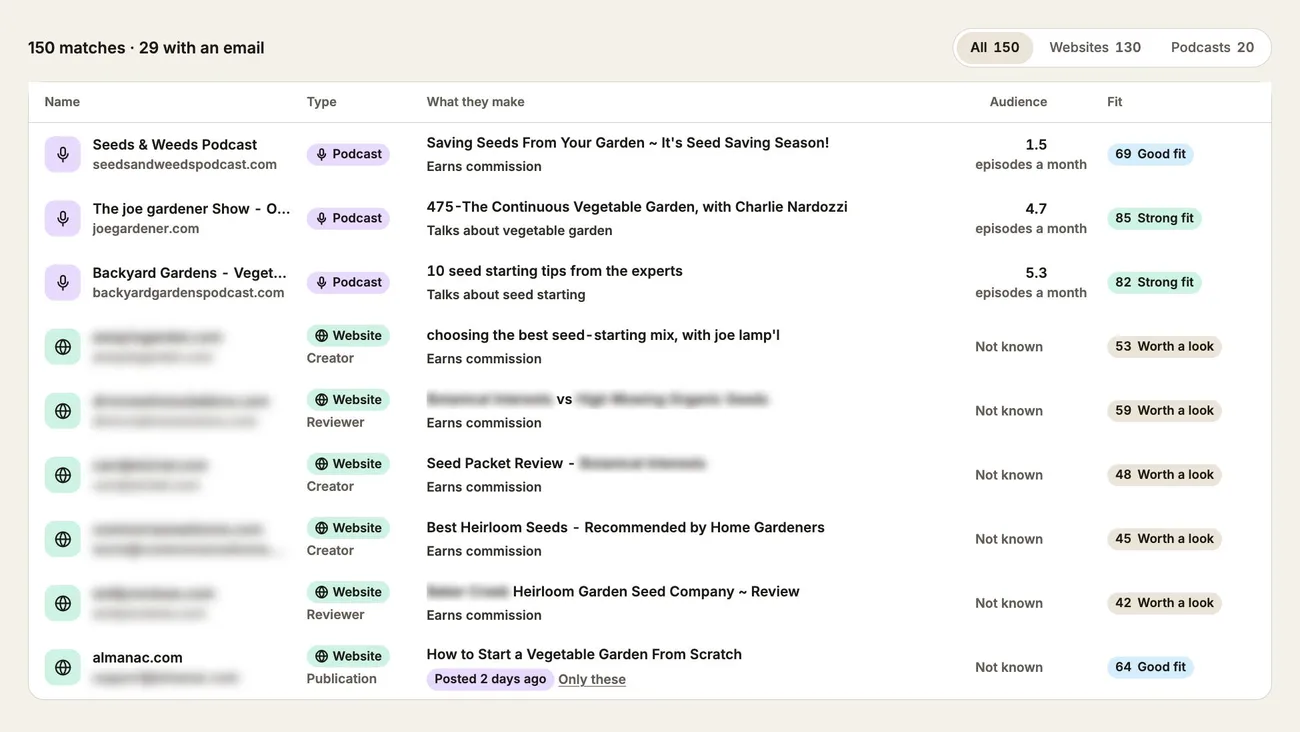
That changes who you seed. In the scan, a seed company's results were mostly gardening bloggers and podcasts. Match the list to where your product is talked about. Review and roundup pages were most of the people our scan showed. Small creators are fine too. See what a micro-influencer is.
The "review" label comes from the page, not the person, and some review-labelled rows were single-post bloggers (see the method). Not everyone shown is a promoter. An AI model read the titles and addresses of 30 random rows and opened none of the pages. 9 looked like non-promoters (30%, likely range 17% to 48%), so open each page before you ship. Before you add anyone to the list, check four things: they cover products like yours, they posted recently, their audience matches yours and they have mentioned brands like yours before.
Mistakes that sink a seeding round
Five common mistakes are below.
- Shipping to everyone. A long list of the wrong people costs real money. Ask first.
- Demanding a post. It turns a gift into a job.
- Skipping the disclosure line. The brand is responsible for what others say on its behalf.
- No code or link. Then you cannot tell a gift that worked from one that didn't.
- Sending more before you check. Wait for the 30-day numbers.
Where RecruitAffiliates.ai fits
RecruitAffiliates.ai finds the people and sends the first email. It doesn't pack or post your product, and it doesn't run your gifts.
You enter your website. It finds the people already covering shops like yours. That includes Instagram and TikTok creators, and also bloggers, reviewers and podcasters. Each one comes with the page that shows it, so you can judge the fit. It looks for each person's email and checks what it finds, so you get a verified email. AI drafts a personal first email. You can add a free-item line and your affiliate sign-up link when you approve the draft.
You approve it, and it sends from your own inbox. Replies land in that inbox. You decide who gets a box. See the Shopify page for the five steps.
Launch is $79 a month for one brand, with a 7-day free trial and no card.
Frequently asked questions
What is product seeding?
It is sending free product to people who fit your brand, with no post required. The aim is that they try it and, if they like it, tell others.
How many products should I send?
Start with 30 to 50 people and one item each. Look at the results after 30 days before you send more.
Do I have to ask for a post?
No. Seeding usually has no post requirement. If they post, the FTC expects them to say it was a gift, so ask them to.
Is product seeding the same as an affiliate program?
No. Seeding gives product and expects no post. An affiliate program pays a commission on each sale. You can run both by sending the gift with an affiliate link.
How do I track results from seeding?
Give each person a unique discount code or affiliate link. Count delivered, posted, sales and cost per sale after 30 days.
Is product seeding the same as influencer gifting?
Close. Both mean sending free product. Gifting often hopes for a post. Seeding asks for none.
Sources
- Aspire, how to promote your Shopify store on a budget, 31 December 2025
- Traackr, 2023 Influencer Product Seeding Report, published 26 April 2023, checked 26 October 2026
- Influencer Marketing Hub, the ultimate guide to product seeding, checked 26 October 2026
- Shopify Help Center, recruiting creators, checked 26 October 2026
- Shopify App Store, Seeding Ops, checked 26 October 2026
- US Federal Trade Commission, 16 CFR 255.5, checked 26 October 2026
- FTC, Disclosures 101 for Social Media Influencers, November 2019
- FTC, The Endorsement Guides: What People Are Asking, checked 26 October 2026
- RecruitAffiliates.ai, Shopify affiliate scan: method and counts, 22 October 2026