
PR package for influencers: what goes in the box
An influencer PR package is a box of free product sent to a creator to try. If they like it, they may share it. A good one holds the product and a short personal card. It also holds a link or code that tracks sales, and a note to say it was a gift. Leave out anything that makes them feel they owe you a post.
An influencer here means a creator with an audience, such as a blogger, podcaster or TikTok account. A box on its own may get you noticed. Add a tracking link, a web address that credits sales to one person. Now the gift can become an affiliate deal. They earn a commission on each sale they send. This guide gives you a packing list, three budget levels and the rules to follow.
What is a PR package for?
It gets your product into a creator's hands so they can say something real about it. The ask is small. You aren't paying for a post. You are giving them a reason to have an opinion.
PR packages work best as the first step of a longer relationship. The box starts the conversation. The affiliate offer, if they like it, keeps it going. Our guide to what to offer affiliates covers the pay side.
What goes in the box?
Pack the product first, then the things that make it easy to say yes. This table sorts items by how much they matter.
| Must have | Nice to have | Skip |
|---|---|---|
| The product itself, full size or a travel size | A small extra that fits their taste | A pile of free merch they won't use |
| A short card, written by hand or typed to them by name | A one-page sheet on how the product works | A long press release |
| A tracking link or code, printed on the card | A second product for a friend to try | A contract or form to sign |
| One line asking them to say it was a gift and to mention any commission | Packaging that opens easily and looks good | Anything fragile or messy |
Three of the four "must have" items cost almost nothing. The product is the big cost, and postage comes on top of it.
The card
The card is the part they read. Write to one person. A good card is four lines.
- One true thing about their content.
- What is in the box, and why it suits their audience.
- The offer: your commission and a link or code.
- A promise of no strings. They can say no.
Here is a short example. Change every part in brackets.
Hi [first name], I loved your [specific post] on [topic]. Here is our [product]. I think your readers who [need] would like it.
If you do, I'd love to offer you [X]% on every sale you send. Your link is [link], and your code is [code].
No strings. If you share it, please say it was a gift and that you earn a commission. Thank you for trying it.
Our affiliate recruitment email guide has the same four-part shape for the email that comes before or after the box.
The link or code
A tracking link records which creator sent a sale. A discount code lets their followers save money and also credits the creator. Put one or both on the card. Without one, you can't tell which box led to a sale. The creator can't earn from it either.
Be careful with codes on public coupon sites. They can end up on deal sites that take credit for sales you'd have made anyway. Our guide on how to stop coupon sites joining your affiliate program explains how to screen for that.
What should a PR package cost?
Whatever you can afford per box, and nothing more. We can't give you prices, because your product, your weight and your postage differ. What we can give is three spending levels and what fits in each. Treat the dollar amounts as your cap per box, including postage.
| Level | Per box (cap) | What fits |
|---|---|---|
| Light | $10 | A sample or travel size, a printed card, a tracking link |
| Standard | $25 | A full-size product, a handwritten card, a link and a code |
| Full | $60 | A full-size product, a small extra, a card, a link, a code and good packaging |
Use the light level for small creators. Use the standard level for creators whose followers already talk back to them. Don't send a full box to a stranger. Earn the bigger box with a yes first.
Here is a way to size your first send.
Our first search on 30 public Shopify brands (22 October 2026) showed 92 people for the typical brand (the middle brand, or median). The typical brand had 30 with an email found. "Email found" means an address was on record. We did not check it. A first send of 20 boxes would cost up to $200 at the light cap or $500 at the standard cap, including postage. The 20 is our pick, not a finding. The 92 shows scale only, because many of those people are web pages, not creators who take parcels. That is a number you can decide on before you buy anything.
The number may be higher on a larger setup. The two runs below used different settings and different brands, so they are not a before and after. On 24 October 2026, on a paid plan with a full setup, 3 Shopify shops showed a median of 693 people each, mostly from YouTube.
| Run | Brands | People shown for the typical brand |
|---|---|---|
| First search, default settings, 22 October 2026 | 30 public Shopify brands | 92 |
| Paid plan, full setup, 24 October 2026 | 3 Shopify shops | 693 |
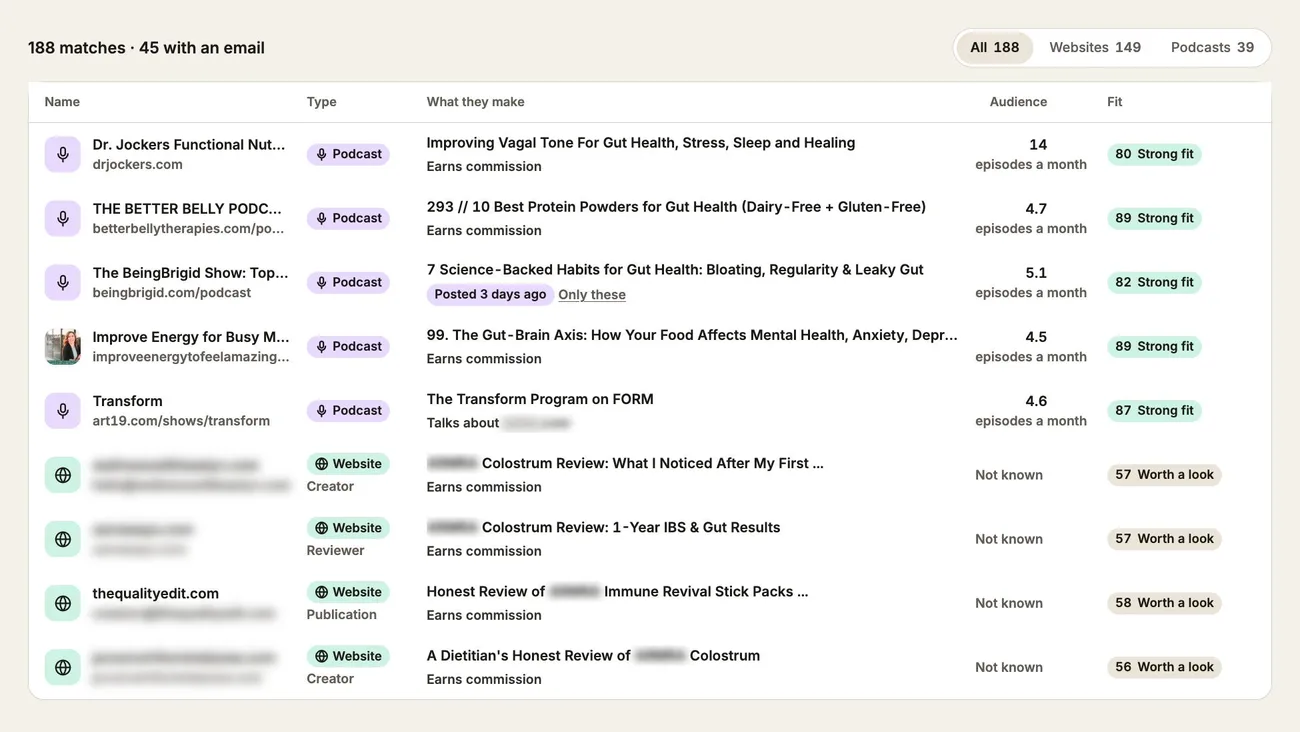
Some of the people shown are not promoters. An AI model read the page title and address of 30 random rows. It judged 9 not to be promoters (30%, a likely range of 17% to 48%). Check each name before you spend on a box. The scan method and limits are on their own page.
Who to send boxes to
People who already cover products like yours. In our view, a cold box to a stranger who has never touched your category is a waste. Search for creators and reviewers who write about your rivals. Write to them first and offer to send the box.
Asking first does two things. It saves you the cost of boxes nobody wants. And it lets the creator say no before you spend. Our guide to finding affiliates for a Shopify store shows where to look. Finding podcast and review site affiliates covers two groups that often review products.
What are the rules on disclosure?
If you give a creator a free product and they mention it, they should say so. The US Federal Trade Commission has a guide for influencers. If a brand gives you free products and you mention one, it says to "make a disclosure even if you weren't asked to mention that product." The disclosure should also be hard to miss (FTC, Disclosures 101 for Social Media Influencers, November 2019, checked 26 October 2026).
So put one line on your card. The FTC describes a "material connection" as a financial relationship, "such as the brand paying you or giving you free or discounted products or services". It adds that "financial relationships aren't limited to money" and says to disclose "if you got anything of value to mention a product". The guide does not name commissions. A commission is a financial relationship, so in our view it belongs in the disclosure too. The FTC is a US body, so check the rules for the places you sell to. For example: "If you share it, please say it was a gift and that you earn a commission." That protects them and you.
When the box should arrive
Send it a few weeks before you hope they will share it. A creator needs time to try the product. Add shipping time on top, and check your carrier's last posting dates around busy periods. Our plan to recruit affiliates before Black Friday gives dated weeks for the holiday rush.
What happens after the box ships?
Send one short follow-up a week or so after it should have arrived. Ask if it got there and if they have questions. Do not ask for a post. Then watch your tracking link and code. They show which creators sent sales, so you know who to send a second box.
Frequently asked questions
What do you put in an influencer PR package?
The product, a short personal card and a tracking link or discount code. Add one line asking them to say it was a gift and mention any commission. Add a small extra that fits their taste if you can. Skip merch, long press releases and anything that asks them to sign something.
How much should a PR package cost?
Set a cap per box that includes postage. A light box can be a sample, a card and a link. A standard box adds a full-size product and a code. Our example caps are $10, $25 and $60. Your costs will differ.
Do I have to send the full product?
No. A sample or travel size works for a first box, especially to a small creator. Send full size once they say they want it or after they've shared the first one.
Should I include a discount code?
Yes, if your affiliate app supports one. A code gives their followers a reason to buy, and it credits the creator. Pair it with a tracking link so you can see which box led to a sale.
Sources
- Our scan of 30 Shopify brands, 22 October 2026: method, counts and limits
- US Federal Trade Commission, Disclosures 101 for Social Media Influencers (November 2019) (checked 26 October 2026)