
How to get affiliates for a Shopify store with no budget
To get affiliates with no money, ask your happy customers first, then the people who review your rivals, then creators and groups where your buyers already talk. An affiliate is someone with an audience who sends you buyers. They earn a commission, a cut of each sale, so you pay only when someone buys. Send a short message and follow up once.
You don't need an ad budget to ask them. You need a list of names and one clear offer. This guide shows where to find the names for free, what to send, and a 14-day plan.
What does "no budget" cost?
Time, and the commission on sales you would not have made otherwise. There is no fee to ask someone to join. Commission is paid after a sale, so it comes out of money you've already taken in.
Two things can still cost cash. A free sample costs you the product and the postage. Affiliate software costs a monthly fee. You can skip both on day one. Add a sample only when a reviewer says they would write about it. Add software when searching by hand gets too slow (see the last section).
Five free places to get affiliates
Each place below costs nothing but time. They are listed from the warmest group to the coldest.
| Place | Who you find | What to do |
|---|---|---|
| Your customers | People who already like your product | Email the ones who left a review or tagged you |
| Pages that review or compare your rivals | Bloggers and review sites with a "best [product]" page | Search each rival's name plus "review" |
| Creators on video | People who test products on YouTube and TikTok | Search your rivals' names and your product type |
| Podcasts in your niche | Hosts who read out codes in ad slots | Search your category plus "podcast" |
| Communities | Forum and group members who answer product questions | Help first, then mention the offer when it fits |
Start with the first two. Customers are the easiest yes. In the 30-brand search below, review pages were the biggest group. A roundup is a page that ranks several brands, such as "best natural skincare brands".
In our first search on 30 public Shopify brands, the strongest page we found for 1,877 of 2,924 people (64%) was a review, roundup or comparison page. The strongest page is the one that best shows they promote products like yours (the 30-brand counts).
A fuller setup shows more, and video is a big part of it. On 24 October 2026, on a paid plan with a full setup, 3 Shopify shops showed 693 people each for the typical shop (the median). Most came from YouTube (the 3-shop follow-up). Not all are good fits. In a rule check, 54% to 83% of the YouTube rows were a strong fit. So add video to your search after customers and review pages. Our guide to finding affiliates for a Shopify store goes deeper on that search.
Shopify's own app, Shopify Collabs, lets you invite creators who are already on it. Per Shopify, you can invite up to 100 creators in any 7-day period (Shopify Help Center, checked 26 October 2026). Shopify's Collabs page says "Collabs isn't accepting new creator signups at this time". So you can only invite creators already on it (Shopify Help Center, checked 26 October 2026). Treat it as another place to look, not the whole plan. Our page on Collabs and its invite limit covers the rest.
What a first search shows
These counts come from our software, not from searching by hand, so a hand search may turn up fewer. We ran our software's first search on 30 public Shopify brands on 22 October 2026. It showed a median (the middle brand when you line them up) of 92 people per brand. A median of 30 of them had an email found (range 5 to 53). "Email found" means an address was on record for that person. We did not check it, because the scan ran no lookups.
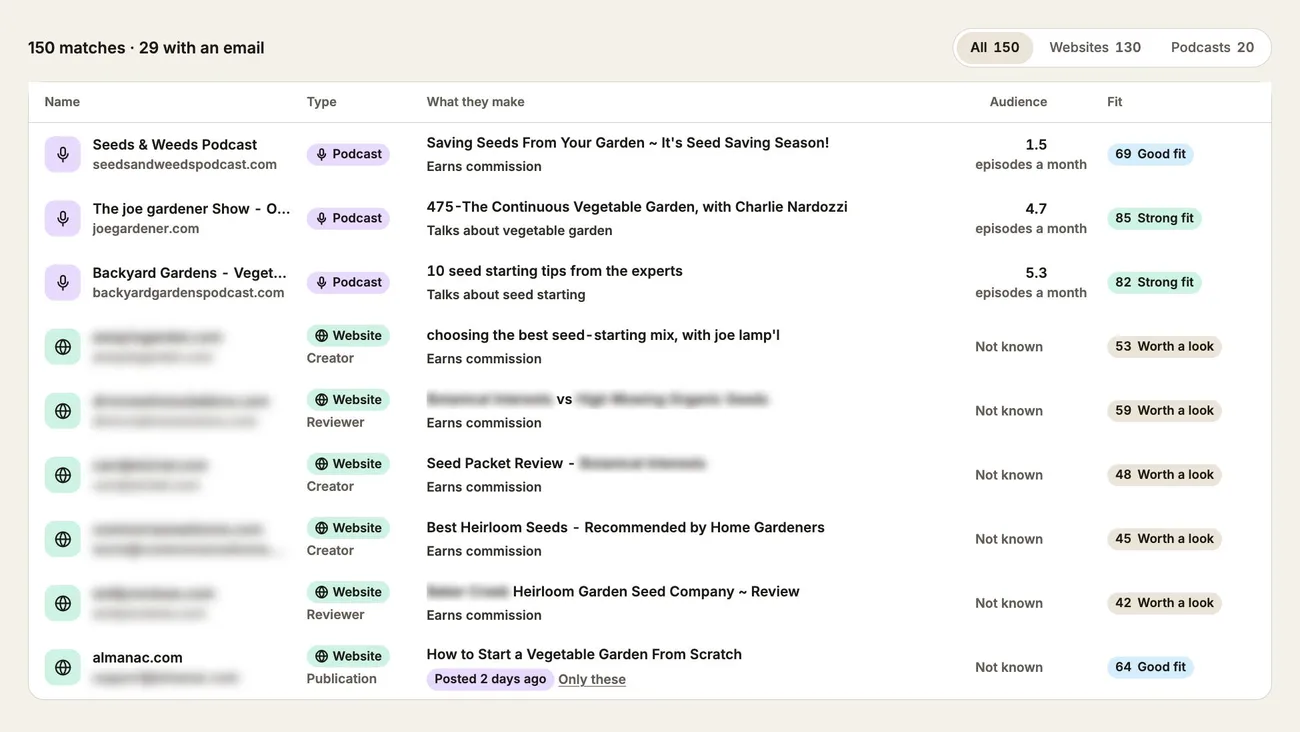
Some of those people are not promoters. An AI model read the page title and address of 30 random rows. It judged 9 not to be promoters (30%, a likely range of 17% to 48% at this sample size). Cross those off. With about 70% real, a typical brand's 92 becomes about 64 good names. Roughly 20 of them have an email found. The shops were hand-picked and searched once, on 22 October. The scan method and limits are on their own page.
The message to send
Keep it short and about them. Use this as a base and change every bracket.
Subject: Your [rival] review
Hi [first name], I read your piece on [rival product]. [One true thing you liked about it.]
We make [your product]. Your readers would like it because [one reason].
I'd like to offer you [X]% on every sale you send. [If you can spare one: I can also send you a free product to try, with no strings on the review.]
Would you like the details?
Four parts do the work, and the sample is optional. Line one (the greeting and first sentence) shows you read their page. Line two says why it fits their readers. Line three names the offer in plain numbers. Line four asks one small question. For a customer, swap line one for "Thanks for your review of [product]." Send one follow-up after four or five days. A new email inbox should start slowly. The first 10 affiliates plan has the day-by-day sending limits and the math. For a fuller template, read how to write an affiliate recruitment email.
If you send a free product, ask the creator to say so when they mention it. Ask them to say if they earn a commission too. The US Federal Trade Commission tells creators to "make a disclosure even if you weren't asked to mention that product" (FTC, Disclosures 101 for Social Media Influencers, November 2019, checked 26 October 2026). That is a US rule, so check the rules for each place you sell to.
A 14-day plan
Spend about an hour a day. The plan assumes you send from your own email inbox. The day 3 target is worked out from the scan figures above. It is not a measured result, and a hand search may give fewer names.
| Days | What to do | What you have at the end |
|---|---|---|
| 1 | Write to the customers who left a review or tagged you | The warmest asks are out |
| 1 to 2 | Pick five rivals and search each name plus "review" | A first list of names |
| 3 | Find an email for each name and drop the weak fits | A target of about 20 people you can reach |
| 4 to 5 | Write the message and send the first 10 | First replies start |
| 6 to 10 | Send the rest, follow up once, answer every reply | Conversations going |
| 11 to 14 | Send each yes a code and your product page link | Your first affiliates |
To track and pay with no software, use your store's own tools. Shopify lets you create percentage discount codes (Shopify Help Center, checked 26 October 2026). Make one code per affiliate, such as a first name plus a number. Each month, list the orders that used each code and pay the commission by hand. In our view, wait until after your return window so you don't pay on sales that come back. Pick a commission your margin can carry. A discount code also cuts your price, and the commission comes on top, so work out both. Our guide on what to pay shows how.
When should you start spending?
When the free search stops being fast enough. In our view, hand searching works for a first batch of about 20 people and gets slow after that. Looking up emails one by one is the first chore to hurt.
Software is the next step, not the first. RecruitAffiliates.ai finds the websites, blogs, review sites, podcasts and creators already promoting your rivals, then gets their email. A lookup is one search for a person's email address, and it checks each one (what each email result means). The 7-day trial costs nothing and needs no card. It includes 20 email lookups. That is enough to test it against your hand-built list. Our post on the best affiliate recruitment software compares the options.
Before you spend on anything, work out your numbers with the free affiliate calculator. It shows how many people to contact for your sales goal. If you sell on Shopify, the Shopify page shows what we found for Shopify brands.
Frequently asked questions
How do I get affiliates with no money?
Ask people who already like your product, then the bloggers and creators who review your rivals. Offer a commission, which you pay only after a sale. Send a short message that shows you read their work, and follow up once.
Do affiliates cost money upfront?
No. Commission is paid after each sale. You may pay for a free sample and postage, and for affiliate software if you choose to use it. Both are optional on day one.
Where do I find affiliates for free?
Start with your customers. Then search each rival's name plus "review" or "discount code" and note who wrote the page. Add creators on YouTube and TikTok, podcasts in your niche, and groups where your buyers ask for advice.
Sources
- Our scan of 30 Shopify brands, 22 October 2026: method, counts and limits and the per-shop CSV
- Shopify Help Center, recruiting creators (100 invites in any 7-day period, checked 26 October 2026)
- Shopify Help Center, Collabs (new creator signups paused, checked 26 October 2026)
- Shopify Help Center, discounts (percentage discount codes, checked 26 October 2026)
- US Federal Trade Commission, Disclosures 101 for Social Media Influencers (November 2019, checked 26 October 2026)