
How to find product review bloggers for your brand
To find product review bloggers, search "[rival] review" and "best [your product]" in Google, then write down the person behind each post. Keep the blogs with recent posts, mixed verdicts and reviews of products like yours. Spend your effort on a short list of the right people, not a long list of anyone. A review that ranks can keep working after the day it goes up.
A product review blogger is one person who writes up things they have tried, such as skincare, gadgets or garden tools. An affiliate is someone who sends buyers to your product and earns a cut of each sale, called a commission. A blogger can review your product once, or become an affiliate and keep sending buyers for as long as the post ranks.
How is a review blogger different from a review site?
A review site is a business that ranks products at scale. A review blogger is one person, often with one voice and a small, loyal audience. Our guide to finding podcasts and review sites covers the first. This one covers the second.
A site has a "work with us" page and a team. A blogger has a contact form, a personal tone, and probably a pile of other offers. You write to them as a person.
Which searches surface product review bloggers?
Use plain Google searches. Swap in your product type and your rivals' names. Then open each result and look for a person's name, not a brand's.
| Search | What it surfaces |
|---|---|
[rival] review | People who already tried a product like yours |
[rival] honest review | Posts that may carry mixed verdicts |
best [your product] for [audience] | Roundups (lists that rank several products), which show who writes them |
[your product type] review blog | Blogs that mainly review |
gifted [your product type] | Posts that say the product was a free sample |
[rival] vs [rival] | Comparison writers |
Don't stop at page one. Keep going past the first results, where smaller blogs may sit, and read who writes the roundups.
Two tweaks to try. Add intitle: before the quoted phrase, as in intitle:"[rival] review", to keep only pages whose title contains it. And search a disclosure phrase next to your product type, like "gifted" "[product type] review", to find bloggers who say what they were given. Exact phrases can return nothing, as the example below shows, so try a few wordings.
Worked example: what "Hydro Flask honest review" returned
On 26 October 2026 we ran "Hydro Flask honest review", a rival in the water bottle category, through a web search tool. It isn't Google, so your results will differ. It returned nine pages. One was a customer-review platform, one a Substack newsletter and one a shop's own blog. We opened five of the other six and applied three of the checks in the next section: recent posts, disclosure and a way to reach them. The sixth blocked us.
- Two were clearly one-person blogs with a named author. One posted in September 2026, carried a disclosure and listed an email address. The other had a contact page but its post dated from 2017, so it failed the recent-posts check.
- One probably had a single writer. It had a byline and a September 2026 post, but no email or form, only an About page and social links. It passes the contact check, though only by a social message.
- Two were publishers. Both had named writers and a contact page, and one said "we" throughout. A pitch there goes to an editor, not to a lone blogger.
So five opened pages gave us one clear lead, one lead reachable only by social message and one stale blog, plus two publishers that need a different pitch.
We also searched the exact phrases "sent to me for free" and "water bottle review". No page had both. If an exact phrase gives nothing, loosen it.
Your tracking sheet
Keep a sheet like this:
| Name | Blog address | Post you found | Date | Contact route |
|---|---|---|---|---|
| Sam | example-blog.com | Review of a rival's bottle | 12 Sep 2026 | Contact form |
We ran the searches on one example only, so treat them as a starting point. Bloggers who reviewed a rival may be easier to approach. They already write the kind of post you want. For more ways to find the rival's coverage, see how to find your competitors' affiliates.
Judging a blog before you email
Spend a couple of minutes per blog. Drop it if it fails the first or last check.
- Recent posts. Look for a post in the last few months. A blog that stopped years ago is unlikely to answer.
- Mixed verdicts. A blogger who loves everything gives readers little to go on. Look for reviews that name a flaw. That's the voice you want.
- Their own photos and detail. A real review shows the product in use. A thin post that copies the maker's text is a sign to skip.
- Your category. Count reviews of products like yours. One review of a blender on a skincare blog is not a fit.
- A disclosure line. A good blogger says when a product was free. The FTC says a free product still needs a disclosure, whether it was shipped, sent as a code or reimbursed (FTC, checked 26 October 2026).
- Real comments. A few thoughtful comments or replies show readers who engage. Zero comments across ten posts is a weak signal of few readers, unless the blog has switched comments off.
- A way to reach them. A contact page, an email address or a social profile you can message. No route, no pitch.
Skip blogs that are mostly coupon lists. They rank deals, not opinions, and coupon sites are a different problem.
Don't rank blogs by follower counts alone. A small blog that ranks for "best [your product]" may matter more to you than a big feed.
Where does a blogger's email hide?
Bloggers often keep their address behind a form, so check these places in order.
- The Contact or Work with me page. Many have a form or a stated address.
- The About page and footer. Some list a business email there.
- Their social profiles. A bio often carries an email or a link to a contact page.
- Their media kit. This is a short page or file of their audience and rates. A blogger who takes brand deals may link one.
Our first search on 30 Shopify brands found an email for 916 of the 2,924 people shown (31%), found and not checked (method). That figure covers every kind of person and doesn't split out bloggers, so assume a form is the likelier route. If you find only a form, use it. A short message there still reaches a person.
What should you send first?
Send an email, not a box. Ask if they want to try the product, and ship only after they say yes and give an address. That respects their time and stops you wasting stock. Our product seeding guide covers the ship-then-follow-up side, and the influencer outreach email template has wording to copy.
Keep it short. Name one of their posts. Say in a sentence why your product fits what they write about. Then ask one question that is easy to answer with a yes or a no. For example:
Subject: Your review of [rival product]
Hi Sam, I read your review of [rival product]. The point about the lid was fair. Ours uses a different seal, so your readers might want to compare the two. Could I send you one to try, with no pressure? All I'd ask is an honest review and a note that it was a gift.
Thanks, Alex
To keep a blogger for the long run, say so in a second email after the review goes up. An offer of a commission, a code or a link is a better follow-up than a request for another post. What to offer affiliates shows the choices.
Asking for a review within the rules
Ask for an honest review. Never ask for a good one, and never pay only for a positive verdict. The rules below come from the US FTC, Google and the UK ad regulator, so check your own market as well.
- Disclosure (US and Google). Ask the blogger to say the product was free. Google says the disclosure can sit anywhere in the post, with the top being most useful (Google Search Central, 11 March 2016).
- Disclosure (UK). The ad regulator says marketing content about a gifted product should be clearly labelled as advertising, with "Ad" up front. It also says brands and influencers share responsibility for making the ad obvious (ASA, advice dated 6 August 2026, checked 27 October 2026). Our disclosure examples give wording you can send.
- Links. The same 2016 Google post says links given in exchange for goods should carry the
nofollowtag, a code on a link that tells Google it was given in return for something. Google's current page prefersrel="sponsored"for paid links and callsnofollowstill acceptable (Google Search Central, updated 10 December 2025, checked 26 October 2026). Ask the blogger to add one of those tags. Buyers can still click. - Your duty. The US FTC says a brand that sends a free product should tell the person how to disclose, and should then check the post. It sets no fixed period and calls a few months "probably reasonable" when there is no contract (FTC, checked 26 October 2026).
Be ready for a mixed review. If a blogger sends a fair criticism, thank them and fix what you can. Reply once and don't argue the verdict. How you take a bad verdict is part of the relationship, and a bad reply can travel.
What happens after the review?
Share it. If the blogger agrees, link to the review from your product page or social feed. Then use a tracked link, a link that records who clicked it, to see whether it sent anyone to your shop. A blogger who sent buyers once is worth a commission offer. If they then use an affiliate link, they need an affiliate disclosure too. One who sent none still gave you an honest review you can learn from.
Expect some silence. A busy blogger may never open a cold email, and a few will say no even to a free sample. That's normal. If you hear nothing, send one short follow-up after about a week, then move on. Track every reply in the sheet.
What did our 30-row check find?
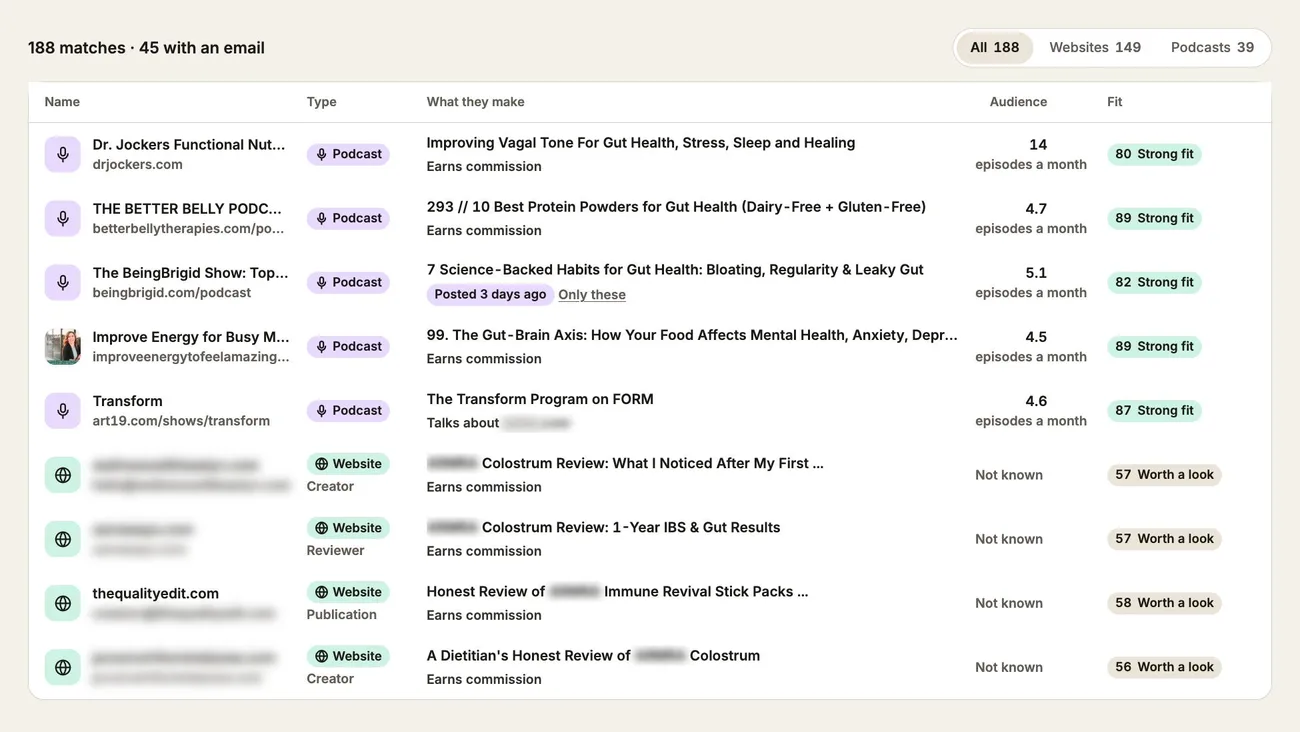
We ran our scanner's first search on 30 public Shopify brands on 22 October 2026. An AI model then read 30 random rows from the 2,924 people it showed, judging each by its page title and web address. No page was opened. Of the 30 rows, 19 had a review-site label (the count is in why 64% of promoters have a review page). Of those 19, about 8 looked like single bloggers with one review post, and 6 were not promoters at all. Blog-style pages were a separate group: 573 of the 2,924 people shown (20%).
So a "review site" label can hide a single writer, and can also hide a page that is no fit. It's a small sample from hand-picked brands, read once. Treat it as a direction, not a rate. The method and its limits are on the scan page, and the wider result is in our study of who promotes Shopify brands.
Where RecruitAffiliates.ai fits
RecruitAffiliates.ai finds the people and sends the first email. It doesn't pack or post your sample, and it doesn't run your gifts.
You enter your website. It finds the people already covering shops like yours. That includes Instagram and TikTok creators, and also bloggers, reviewers and podcasters. Each one comes with the page that shows it, so you can judge the fit, such as the review of your rival. It looks for each person's email and checks what it finds. Where it confirms one, you see a verified email result with the page it came from. AI drafts a personal first email. You approve it, and it sends from your own inbox. Replies land in that inbox.
A campaign is four emails in one thread. Launch is $79 a month for one brand, with a 7-day free trial and no card.
Frequently asked questions
Do I have to pay a blogger to review my product?
You don't have to. Some bloggers will review a free sample. If you do pay, the payment must be disclosed too, as the FTC says. Never pay for a positive verdict only.
What if a blogger asks me to pay?
You can say yes, but the post then counts as paid and the payment must be disclosed along with the product. Start by offering a sample and a commission, and agree a fee only for one post you can measure.
How many bloggers should I contact?
Start with a small list you can personalise, such as 20 to 30. That's our rule of thumb, not a tested number. Widen it once you see who answers.
Find the bloggers who already cover your rivals
Try RecruitAffiliates.ai free. The 7-day trial includes 20 email lookups, and it needs no card.
Sources
- Our first search on 30 public Shopify brands and a 30-row check, 22 October 2026: method and limits and who promotes Shopify brands
- FTC, Endorsement Guides: What People Are Asking: FTC FAQ (checked 26 October 2026)
- Google Search Central, Best practices for bloggers reviewing products they receive from companies: Google post (11 March 2016, checked 26 October 2026)
- ASA, Recognising ads: Social media and influencer marketing: ASA advice (6 August 2026, checked 27 October 2026)
- Google Search Central, Qualify your outbound links: Google page (updated 10 December 2025, checked 26 October 2026)