
Who promotes Shopify brands? Review pages are 64% of the people shown
Who promotes Shopify brands? Most of the people our first search showed for 30 public Shopify brands had a review or roundup page. That is 1,877 of the 2,924 people shown (64%), counting each person's strongest page. Blog-style pages came next at 20%, then podcasts at 14%. The search ran on 22 October 2026.
An affiliate is someone with an audience who sends you buyers and earns a commission, a cut of each sale. A roundup is a page that ranks several brands, such as "best natural skincare brands". A first search is the list RecruitAffiliates.ai builds the first time you add a brand. This post gives the table, explains how we counted, and says what to do with it.
What did we find?
Here is every person the first search showed, by the type of their strongest page.
| Type of page | People | Share |
|---|---|---|
| Review, roundup or comparison page | 1,877 | 64% |
| Blog-style page | 573 | 20% |
| Podcast | 399 | 14% |
| TikTok | 49 | 2% |
| 17 | 0.6% | |
| Newsletter | 9 | 0.3% |
| All people shown | 2,924 | 100% |
The shares are of the 2,924 people shown, across all 30 Shopify brands. The Instagram and newsletter rows are small. We would not read much into them. The full tables, with the CSV, are on our research page on who promotes Shopify brands.
How did we count?
We added each of 30 public Shopify brands to RecruitAffiliates.ai. For each we typed two rivals and three topics by hand, then ran the normal first search. It looks at websites, podcasts, TikTok and Instagram. The counts are the people it showed after its own filter. It found 5,537 candidates and hid 2,613, so 2,924 were shown.
Each brand was searched once, on 22 October 2026. The 30 Shopify brands were picked by hand, six in each of five categories. The categories are in the table further down. Three of each six were UK shops and three were US. The method page has the full detail and the per-shop CSV has the counts for each shop. No brand names are shown anywhere.
What does "review-style" mean?
It is a label on the page, not on the person. For each person the search keeps the page that best shows they cover a product like yours. When that page is a review, a roundup or a comparison, we call it review-style. It does not mean the publisher is a review site.
We checked 30 random rows. An AI model read each title and address, and no page was opened. 19 of the 30 carried the review label. 6 of those 19 were judged not to be promoters at all. About 8 looked like individual bloggers with one review post, and one looked like a podcast directory. So read the 64% as "has a review, roundup or comparison page". It does not mean "is a review site".
Does it differ by category?
Yes. Skincare and fashion leaned most on review pages. Supplements leaned least, because podcasts took 20% there, the highest of the five.
| Category (6 Shopify brands each) | People shown, median per brand | Review-style share |
|---|---|---|
| Beauty and skincare | 100 | 73% |
| Fashion and apparel | 78 | 72% |
| Fitness and sports | 94 | 65% |
| Home and garden | 92 | 61% |
| Health and supplements | 126 | 55% |
The median is the middle brand when you line the six up from smallest to largest. With six brands, it is the average of the middle two. The share column adds each category's review-style people across its six brands. With six brands a category, treat these as rough. Each category has its own page: skincare, fashion, fitness, home and garden and supplements.
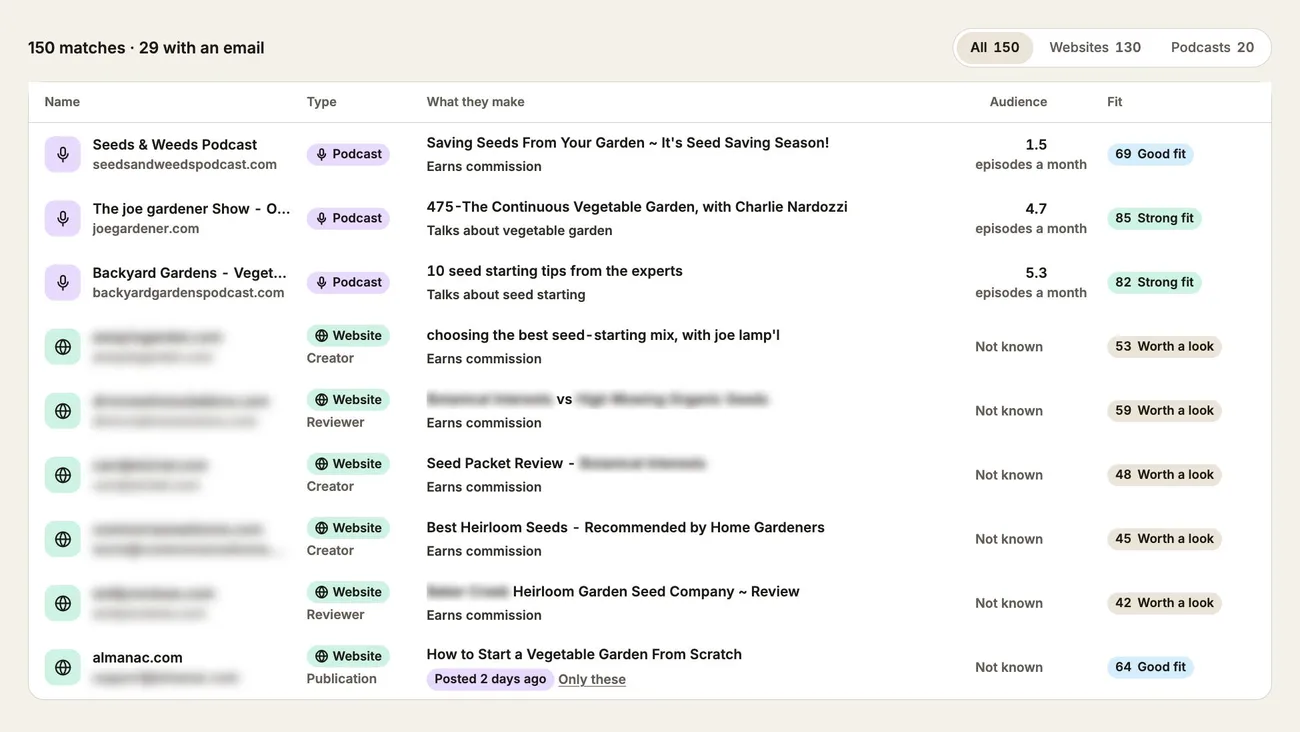
Here are two single searches. The screenshot above is a US home and garden brand. It showed 151 people: 48 review-style, 83 blog-style and 20 podcasts. A US supplements brand showed 188: 79 review-style, 69 blog-style and 39 podcasts. Neither is close to the 64% overall (32% and 42%). Your own mix will differ, so run your own search before you plan.
What should you do with it?
Three things.
- List the review pages that rank your rivals. Search "best [your product type]" and "[rival] review". Write down who made each page and whether your brand is on it.
- Offer reviewers a sample and a clear commission. A reviewer can't write about a product they haven't tried. Our guide to finding affiliates for a Shopify store has the full method.
- Screen out deal pages. Some review pages are really coupon pages. Our guide on how to stop coupon sites joining your affiliate program shows how.
If your category leans on podcasts, add them next. Finding podcast and review site affiliates covers both groups.
What are the limits?
- A small, hand-picked sample. 30 brands, six a category, chosen for fit. Not a random sample of Shopify.
- One search, one day. Counts move with the search sources.
- Not all promoters. In the 30-row check, the AI model judged 9 not to be promoters (30%, a likely range of 17% to 48%, which is wide because the sample is small). So about 70% look like real prospects, with a likely range of 52% to 83%. Treat the counts as an upper limit.
- Default settings. Each brand inherited our own offer and countries. A larger setup showed more. The two runs are not a like-for-like comparison. On 24 October 2026, on a paid plan with a full setup, 3 Shopify brands showed a median of 693 people each. Most came from YouTube (the follow-up).
- UK and US are not a fair comparison. The UK brands were smaller, with estimated sales of $25k to $100k a month against $100k to $250k for the US ones. Those sizes came from a list we did not check.
- Rough labels. Blog, review and newsletter labels come from the page type and address.
Frequently asked questions
Who promotes Shopify brands?
In our first search on 30 public Shopify brands, 64% of the people shown had a review, roundup or comparison page as their strongest page. Another 20% had a blog-style page and 14% a podcast. TikTok, Instagram and newsletters made up under 3%.
How many are review sites?
We can't say. 64% had a review-style page, but that is a label on the page, not the publisher. In a check of 30 random rows, 19 carried the review label. 6 of those were not promoters, and about 8 looked like individual bloggers.
Do review pages differ by category?
Yes. Review-style pages were 73% of people shown for skincare and 72% for fashion, against 55% for supplements. Podcasts took a bigger share of supplements, at 20%, .
Sources
- Our scan of 30 Shopify brands, 22 October 2026: method, counts and limits and the per-shop CSV
- Our research page, who promotes Shopify brands, with the follow-up of 24 October 2026
- The "likely range" on a sample of 30 is a Wilson score interval