
How to find affiliates for your SaaS, step by step
The best place to start is with who already writes about your rivals. Search Google and YouTube for reviews and "best of" pages, note who wrote them, then email those people. Tools can speed this up, so eight are compared first. The steps to do it by hand follow.
An affiliate is someone with an audience who recommends your product and earns a cut of each sale. That cut is their commission. A recurring commission keeps paying while the customer keeps paying you. We make RecruitAffiliates.ai, so it's in the tool table below. Every outside fact links to the vendor's own page, read on 23 October 2026. Our editorial policy says how we check and date facts and how we use our own scan data. Benchmarks from affiliate-software vendors are marked as vendor-reported.
| Tool | What it finds | Entry price we saw | Free trial or plan | Best for (our view) |
|---|---|---|---|---|
| Google and YouTube searches | Review, comparison and "best of" pages, and review videos | $0 | Free | A first short list |
| Ahrefs | Pages that link to a rival | £99 a month (Lite), shown in pounds | Free backlink checker shows a preview | SEO-minded founders |
| Endorsely | Affiliates, up to 15 on the free plan | Free plan, then $39 a month | Free plan | Founders who want a finder inside a free plan |
| Partnero | Websites, creators, agencies and publishers, via Affiliate Discovery | $59 a month, or $49 billed yearly | 30-day trial | A program and discovery in one tool |
| Reditus | SaaS-focused affiliates, through an Affiliate Finder and a marketplace (per its guide) | 99 a month on Growth, billed yearly (price shown as "99" with no currency symbol, so check its page) | 14 days on Growth, no card | SaaS teams that want a marketplace |
| AffiliateFinder.ai | Creators and affiliates across Google, YouTube, Instagram and TikTok | $99 a month, or $69 billed yearly (Pro) | 7 days | Brands that want creators |
| Modash | Creator profiles and contact emails | $199 a month (Essentials) | 14 days, no card | Brands that lean on creators |
| RecruitAffiliates.ai | Websites, blogs, review sites, newsletters, podcasts, YouTube channels, and Instagram and TikTok creators | $79 a month (Launch) | 7 days, no card | Finding people, then emailing them |
"Best for" is our reading of each tool's own words, not a verdict. Prices are in the currency each page showed us, read on 23 October 2026. They change, so check before you buy.
How do you find affiliate partners for your product?
Start with who already writes about your rivals. Five steps get you a short list. If the term is new, start with what affiliate recruitment is.
- Search Google for
[rival] review,[rival] alternatives,[rival] vsandbest [your category] tools. - Open every result that isn't a rival's own site. Note the writer, the site and the date.
- Search YouTube for
[rival] reviewandbest [category] software. Look at the last twelve months. - Read the newsletters and podcasts in your category: sponsor lines, show notes, "tools I use" pages.
- Keep a note of the one page that made you pick each person. You'll open your email with it.
A recent page may suggest the writer is still active. Work through three rivals to start. That's our advice, and the time it takes depends on your category. For the full method on spotting tracked links, see how to find your competitors' affiliates. For more places to look, see where to find affiliates.
Five kinds of people promote SaaS products
Here is where each shows up and what to look for. The order is not a ranking. Agencies and consultants are a different route, covered in partner or affiliate program.
- Review and comparison sites. Pages titled "best X tools" or "X vs Y". Look for buttons that go to a rival through a tracked link. A tracked link has a code in it that tells the company which affiliate sent the visitor.
- Newsletters. The reader chose to get the email. Search
[your category] newsletterand read the archive for sponsor lines. - YouTube reviewers. Some put links in the description, with a line such as "I earn a commission". Open the description and look. The US Federal Trade Commission says an endorser should make a material connection obvious, and that covers getting anything of value to mention a product (FTC, Disclosures 101, November 2019, checked on 23 October 2026). Ask affiliates to disclose their links in your terms. That is guidance, not legal advice.
- Podcasts. Look for shows that interview founders or review tools. Read the show notes.
- Communities and your own users. Forums, Slack groups and happy customers. Join the conversation before you pitch, and follow each community's rules. For what B2B tools offer agencies and communities, see affiliates for a B2B SaaS. To set up a program that rewards customers, see B2B referral marketing for a SaaS.
What did our scans return?
Our scanner searches websites, YouTube and podcast directories for a brand profile, plus TikTok and Instagram for one of them (Instagram and TikTok search is now on for every account, docs). We counted the results on 22 October 2026 through a read-only database role, so the figures come from our own product data and you can't re-run them. The sample is small: five profiles, one of them ours. The count covers 1,759 results that weren't hidden, from five brand profiles. They came from 13 finished scans, run between 22 September and 21 October 2026. One profile is ours.
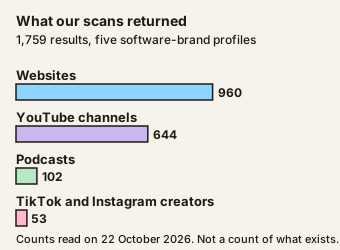
Websites were 54.6% of the results and YouTube channels 36.6%. The scanner decides what it searches, so this shows what it returned, not how many of each exist.
A separate check reads each website's home page and labels it. It had labelled 597 of the 960 websites. The label is version 2 of our own home-page check, which reads the home page with an AI model.
| Home-page label | Websites | Share of those labelled |
|---|---|---|
| Independent sites, such as blogs, comparison sites and publications | 191 | 32.0% |
| Software vendors | 260 | 43.6% |
| Agencies | 84 | 14.1% |
| Directories and coupon sites | 51 | 8.5% |
| Platforms and unknown | 11 | 1.8% |
So about a third of the labelled websites were independent sites. The rest sold software or services, or listed other sites. Search results mix all of these, so open each site before you write.
Limits. The labels come from an AI check of each home page, and its error rate is unmeasured. The other 363 websites had no label, and we don't know why those were skipped. We haven't measured how many searches run for each channel. All five profiles are software brands, ours included, so the sample leans that way. It's a guide, not a benchmark. On 22 October 2026 we read the domain and the check's one-line reason for 30 random labelled rows. 29 looked consistent. One, an agency, was labelled a vendor. That quick read is not an error rate.
Offer a recurring percentage of what customers pay
Pay a percentage of what the customer pays, for as long as they pay. Rewardful reports that most SaaS programs use commission percentages between 20% and 30%, with some up to 40% for top affiliates. It bases that on its own data report of over 2,600 SaaS programs, and calls recurring commissions "standard practice". This is vendor-reported: Rewardful sells affiliate software. The page was last updated on 16 December 2025.
Let's say your plan costs $50 a month and you pay 30% recurring. Each customer earns the affiliate $15 a month while they stay. The sum is ours, not a benchmark.
Next, the cookie window. A cookie window is how many days after a click the affiliate still earns. We found no neutral source for a typical length, so check what your tracking tool allows before you promise one. Our guide to what to offer affiliates covers the rest, and affiliate marketing for SaaS shows how the whole program fits together.
Expect many people to send nothing. FirstPromoter reports on 3,425 subscription programs using July 2026 data. In the median program, 15% of approved affiliates ever produced a referral,. FirstPromoter also sells affiliate software, so treat it as vendor-reported. We'd start with a short list of well-chosen people.
How do you check someone is a fit?
Ask five questions of each name. The list is ours, not a standard.
- Do their readers match your buyers? A blog for designers is a poor fit for an accounting tool.
- Have they posted in the last three months? An abandoned blog may send few visitors.
- Do they already use tracked links? If so, they know the deal.
- Do they write honest reviews? Look for a post that names a downside.
- Can you reach them? Look for a contact page or an email on the About page.
Drop anyone who fails the first two. Pick a first batch of about twenty. That is a rule of thumb.
From list to first sale: six pipeline stages
A pipeline is a board that sorts everyone you're talking to by how far along they are. For a SaaS affiliate, the stages run like this.
- Found. The name is on your list, with the page that made you pick them.
- Emailed. You've sent a short first email that mentions that page.
- Replied. They answered. Read the reply and answer it quickly.
- Joined. They accepted your terms and have a tracked link.
- Linked. The link is live in a post, video or newsletter.
- First sale. Someone paid through the link. Pay the first commission when you said you would.
The early stages, 1 to 3, are where a tool saves the most time. At RecruitAffiliates.ai the board covers those stages. It finds the websites and creators (how discovery works). It looks for an email for each one and shows a verified email where the check passes (how email lookups work). It sends a personal sequence from your inbox, and you reply to the answers (how replies work). A sequence here is four emails in one thread (how campaigns work). A new mailbox sends 5 first emails a day in week one, building to 30 at most (how sending works).
Stages 4 to 6 happen in your affiliate tracking tool, and our SaaS affiliate software checklist says what to check before you buy one. RecruitAffiliates.ai hands new partners to AffiliateRail, a product from the same team that tracks sales and pays commission (how the handoff works). Two kinds of pipeline tool exist. A recruitment pipeline helps you find and email people. PRM software (partner relationship management) runs partners after they've joined. Check which one a tool does. For the full comparison, see affiliate partner pipeline software. For the email itself, see the affiliate recruitment email.
Pick a tool by the job it does
Four questions decide it. How many names do you need? Do you need an email for each one? Do you want the emails sent for you? What can you spend each month? If you need ten names and have a free afternoon, use the free methods. If you need hundreds of names with emails, a finder saves weeks. If you want creators with large followings, use a creator search. The table above lists eight options in no ranked order. Here is how we'd sort them.
- Free: Google and YouTube searches, plus Ahrefs' free backlink checker. They cost time, not money. Ahrefs describes its free backlink checker as a preview of the paid tool.
- Affiliate finders: Endorsely, Partnero, Reditus, AffiliateFinder.ai and RecruitAffiliates.ai. They search for you. Check what each one does after the search, such as finding contacts or sending email.
- Creator search: Modash is built around creator profiles.
Launch is $79 a month for one brand, or $790 a year. Grow is $199 a month for up to five brands, or $1,990 a year. The trial lasts 7 days with no card, and we find your first 20 emails free (pricing, checked on 23 October 2026). It covers finding and emailing people. Tracking and paying commission happen elsewhere, and it hands new partners on, as the handoff docs describe. How we score explains how it ranks results. Each claim about our own product above links to the page that backs it. For other options, see the best affiliate prospecting tools and AffiliateFinder.ai alternatives. If you only need ten names, the free method above may be enough.
To start today, try the free competitor checker, or start a 7-day free trial. No card. Plans and limits are on the pricing page.
Frequently asked questions
Where do you find affiliates for a SaaS product?
On the review sites, YouTube channels, newsletters and podcasts that already cover your category. Search "[rival] review" and "best [category] tools", then open each result and note the writer.
How much commission should a SaaS affiliate program pay?
Between 20% and 30% of revenue is the range Rewardful reports from its own data, and recurring is the usual shape. It is one vendor's figure, so test it against your margins.
How many affiliates do you need?
Fewer than you'd think. FirstPromoter reports that the median program has 15% of approved affiliates ever producing a referral. Start with about twenty well-matched people. For a sum from a revenue goal, see how many affiliates a SaaS program needs.
Can you find affiliates for free?
Yes. Google, YouTube and Ahrefs' free backlink checker cost only time, and Endorsely's free plan finds up to 15 affiliates. Paid tools add email lookup, outreach or both.
What is the difference between finding and managing affiliates?
Finding happens before someone joins: building a list and writing to people. Managing happens after: tracking sales, setting commission and paying out.
Sources
All checked on 23 October 2026, except the scan counts below, read on 22 October 2026.
- FTC, Disclosures 101 for social media influencers (November 2019)
- Rewardful, affiliate commission explained (page updated 16 December 2025)
- FirstPromoter, affiliate program management data (July 2026 dataset, 3,425 programs)
- Ahrefs pricing and Ahrefs backlink checker
- Endorsely pricing
- Partnero pricing and Partnero Affiliate Discovery
- Reditus pricing
- AffiliateFinder.ai
- Modash pricing
- RecruitAffiliates.ai pricing, how we score, discovery docs, email docs, reply docs, campaign docs, sending docs, pipeline docs and handoff docs
- Our scan counts: results not hidden across five brand profiles, from 13 finished scans between 22 September and 21 October 2026, read on 22 October 2026 through a read-only database role.